



Set your air conditioner to 25 to 27 degrees for cooling. That is the Australian Government’s energy rating guidance, and it warns that every degree lower could add around 10 percent to your electricity bill. For most Melbourne homes, start at 25, give it half an hour, and only go down a degree if you are still uncomfortable.
That is the number. What it leaves out is everything that makes 25 degrees feel fine one day and stuffy the next: humidity, the afternoon sun on a west facing window, a ceiling fan or the lack of one, and the way a Melbourne afternoon can drop ten degrees or more when the cool change comes through.
This guide covers the setting for each of those days, the one myth that costs people the most, and what it means when 25 is not cool enough.
Why 25 to 27 Degrees, and Not 18
The Australian Government’s energy rating site suggests 25 to 27 degrees in summer and 18 to 20 in winter. It also says that setting it lower for cooling could cost you 10 percent more for each degree. Go from 25 down to 20 and you could be paying a lot more to run the same room.
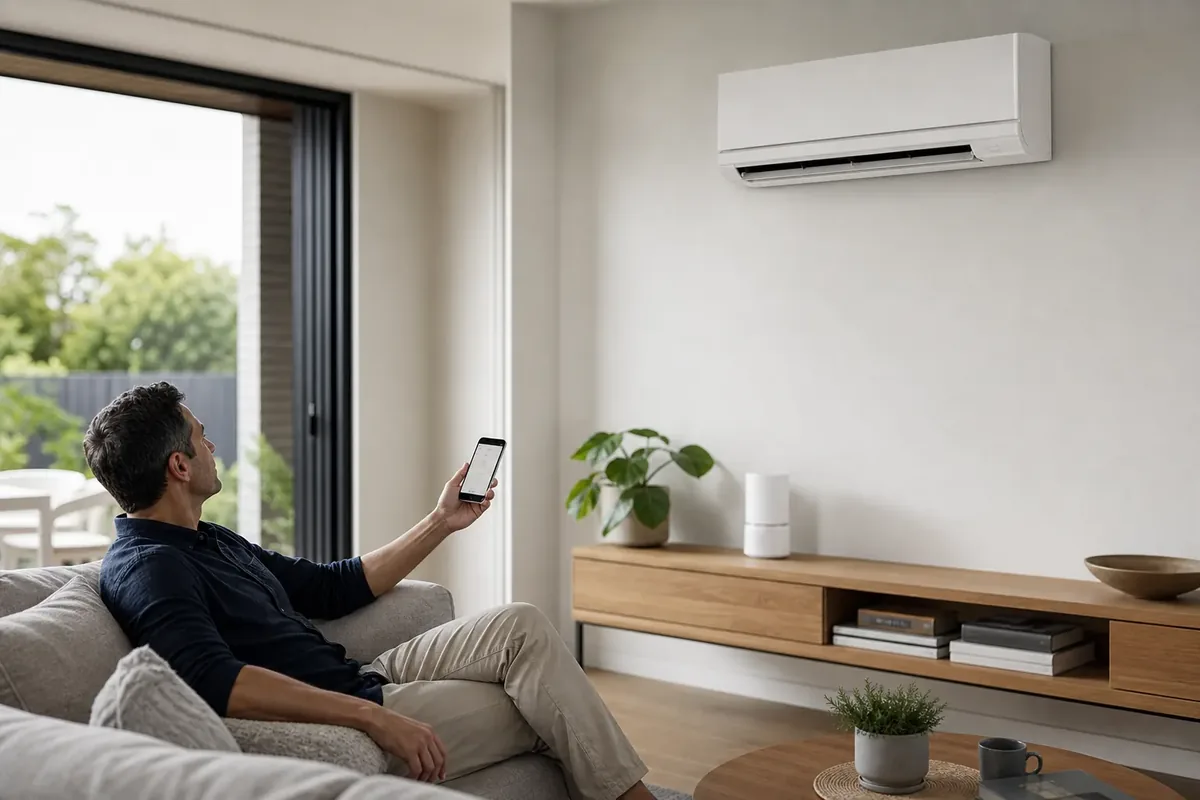
The setting is the temperature you are asking the room to reach. It is not a power dial. So the most common mistake with the remote is an expensive one:
Walk into a hot house, grab the remote, set it to 18 to “cool it down faster”.
On most systems that does not cool the room any faster. The unit runs flat out either way until it nears the set temperature. Set to 18, it keeps going past the point where you were comfortable, and the room ends up colder than you wanted, on a bill you did not need. Set 25, and let it work.
If 25 still feels warm, the problem is usually not the number. It is moisture, moving air or the unit itself, and the sections below deal with each.
Setting It for the Way a Melbourne Summer Actually Runs
Melbourne does not have one kind of summer day. It has several, sometimes in the same afternoon.
| The day | What to do | Why |
|---|---|---|
| Hot northerly, dry heat | Cool mode, 25 to 26, blinds down | Keeping the sun off the glass does a lot of the work for the air conditioner |
| Warm and sticky, overcast | Dry mode, or cool at 26 | Humidity is the problem, not heat. Drier air feels cooler at the same number |
| The cool change arrives | Turn it off and open the house up | Once it is cooler outside than inside, fresh air is free |
| Three or four hot days in a row | Leave it on at a steady 25 to 26 through the worst of it | A house that heats right through is slow to bring back down |
| A hot night after a hot day | Cool at 25 to 26, or sleep mode if your unit has it | Bedrooms hold the day’s heat in the walls and ceiling |
The sticky row deserves a second look. Humidity is why 25 degrees can feel close and damp, and why turning the number down does not seem to help. Your skin cannot cool itself when the air is already wet. On those days, drier air does more than colder air. Our guide to dry mode vs cool mode explains when to switch.
Use a Fan With It, Not Instead of It
Moving air feels cooler on your skin than still air at the same temperature. That is why a room at 26 degrees with a ceiling fan turning often feels better than a still room at 24.
Fans do not cool the air. They just help your body shed heat. So a fan plus the air conditioner on a higher setting is a good pairing, and a fan in an empty room is a fan wasting power. Turn it off when you leave the room.
Close the doors to the rooms you are not using as well. A split system sized for a lounge will struggle if the hallway, two bedrooms and the kitchen are all open to it. With ducted, switch off the zones nobody is in. Our running cost calculator shows how much the hours and the size of the space change the cost.
Leave It Running or Switch It Off?
There is no single answer, and anyone who gives you one is guessing about your house. What is true for most homes:
- If you are out for the day on a mild day, turn it off. No point cooling an empty house.
- During a run of hot days, a house that is allowed to heat right up takes a long time to cool down again, because the walls, ceiling and furniture have soaked up the heat. Many people find a steady setting through the worst afternoons more comfortable than a hard restart at 6 pm.
- Use the timer if your unit has one, so it starts half an hour before you get home rather than running all day.
- When the cool change comes through and the evening air outside drops below the inside temperature, turn it off and open the windows.
Whichever you choose, the setting still matters more than the hours. A unit running at 25 costs less than the same unit fighting to hold 21.
What Temperature Should You Set at Night?
Bedrooms are hard work in a Melbourne heatwave. The day’s heat sits in the ceiling and walls and keeps coming out well after dark. Most people sleep fine at 25 or 26 with a ceiling fan.
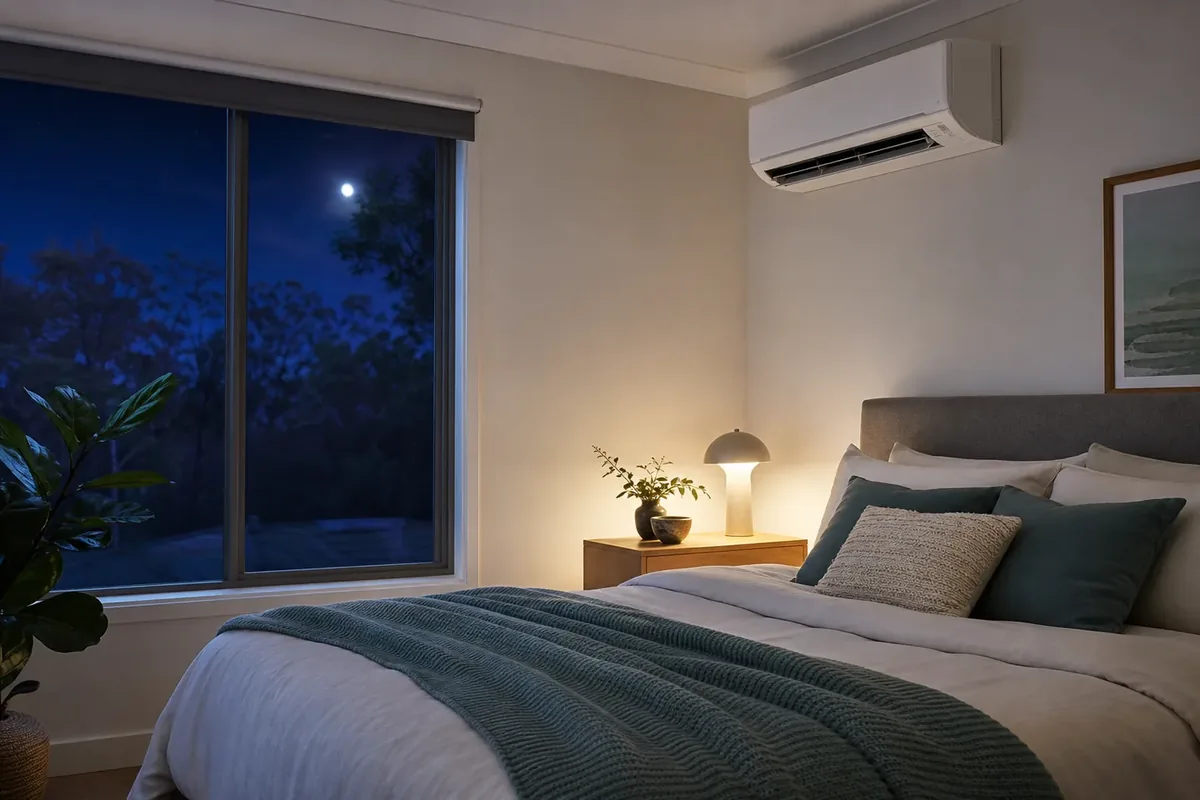
Many units have a sleep or night mode that raises the set temperature slowly over the first few hours, since you need less cooling once you are asleep. On many models it quietens the fan too. Check your remote for a moon symbol, and the operation manual for exactly what your model does.
If the bedroom never gets comfortable, look at the size of the unit and where it sits. A small split on the far wall of a large main bedroom, or one bedroom being cooled by a unit in the hallway, will struggle on a 38 degree night whatever you set.
Choosing a new unit for that room? Our guide to inverter air conditioners explains what to compare beyond the price.
Room Still Hot at 25 Degrees?
If your air conditioner cannot hold a reasonable setting on a hot afternoon, it may need a service, a regas or a larger unit. Tell us what it is doing and we will look at it.
When 25 Degrees Is Not Enough
A working, properly sized air conditioner should be able to hold 25 to 26 degrees in the room it serves on most Melbourne summer days. If yours cannot, the setting is not the problem. These are the usual causes:
- Dirty filters. They choke airflow and the unit cannot move enough air. Clean them and try again.
- The outdoor unit is struggling, boxed in by plants, a fence or clutter, or baking in full afternoon sun with no room to shed heat.
- The room is bigger than the unit. A 2.5 kW split in a 40 square metre open plan living area will run flat out and never catch up. Our size calculator gives a starting point.
- Low refrigerant from a leak, which needs a technician to find and fix.
- Sun on the glass. A big west facing window with no blind can overwhelm a correctly sized unit by late afternoon.
Our guide to why an air conditioner stops cooling goes through these checks in more detail. If it has been a couple of summers since anyone looked at the unit, a service usually comes first. A standard split system service with us is from $150.
Who Should Not Run It Warm in a Heatwave
The 25 to 27 guidance is about saving energy, and for a healthy adult on a normal summer day it is a sensible place to sit. in a heatwave, staying cool matters more than the bill for some people.
The Better Health Channel’s advice on staying safe in extreme heat lists people over 65, babies and young children, pregnant women and people with health conditions among those most at risk, and suggests using air conditioning or fans to keep cool. If someone in your home is in one of those groups, set the temperature for their comfort, check on them through the hottest part of the day, and follow their doctor’s advice on medicines and heat.
Questions About Air Conditioner Temperature in Summer
Is 24 degrees too cold for an air conditioner in summer?
Not too cold, but it costs more than it needs to. The government guidance is 25 to 27 degrees, and each degree lower could add around 10 percent to running costs. If 25 feels warm, try a ceiling fan or dry mode on humid days before going lower.
Does setting the air conditioner to 18 cool the room faster?
On most systems, no. The unit cools at its normal pace until it gets close to the set temperature, whatever that number is. A low setting just means it keeps going past comfortable and uses more power doing it.
Should I leave the air conditioner on all day in a heatwave?
During a run of very hot days, many people find a steady setting of 25 to 26 more comfortable than letting the house heat right up and cooling it again in the evening. On milder days, or when nobody is home, turn it off or use the timer.
What is the best temperature for sleeping in summer?
Most people sleep well at 25 or 26 with a ceiling fan. Sleep or night mode, if your unit has it, raises the setting slowly through the night, and on many models quietens the fan.
Is it cheaper to run a fan or the air conditioner?
A fan uses far less power, but it only helps your body lose heat. It does not lower the room temperature. On mild days a fan may be all you need. On hot days, running both lets you set the air conditioner higher.
Planning for next summer rather than this one? Our pages on split systems and ducted reverse cycle air conditioning cover the options, and our guide on how often to service an air conditioner covers keeping the one you have in shape.