



There is no sound quite like it, is there? The dull hum of the compressor kicking in, the fan whirring away, and yet the air drifting out of the vents is about as cold as a cup of tea left on the bench for an hour. You check the display, you drop the temperature another two degrees, and still, nothing. Just warm, stale air circulating around the room while the unit works its heart out.
It is one of the most frustrating things about owning an air conditioner, and it always seems to happen on the hottest day of the year. Before you panic and start pricing up a brand new system, take a breath. in our experience, the majority of these callouts are caused by a handful of common faults, and a few of them you can sort out yourself in a couple of minutes with no tools and no prior experience.
This guide walks you through the quick checks you can do right now, then moves through the real mechanical causes we see in the field. We will be straight with you about what is a simple fix and what is a job for a licensed technician, so you know exactly where you stand.
An air conditioner that runs but will not cool is usually a dirty filter, a blocked outdoor unit, low or leaking refrigerant, or the thermostat set wrong. The filter, the breaker and the settings you can check yourself in a few minutes. Refrigerant and electrical faults need a licensed technician.
Start here: the two-minute checks
We know you want cold air, not a lecture, so let us get straight to the point. A surprising number of no-cooling callouts we attend are solved before we even get the ladder out of the van. Often, the problem is not a broken part at all, it is something simple that got overlooked. Do these checks first.
Check the thermostat is set to cool and the temperature is set below the current room temperature. It sounds obvious, but we have been to houses where the unit was set to fan mode or the temperature was sitting at 26 degrees on a 38-degree day. If your thermostat runs on batteries, replace them if the screen is blank or flickering.
Have a look at the air filter on the indoor unit. If it looks like a layer of grey felt, it is clogged. Pop it out, vacuum it, or wash it if it is the washable kind, and let it dry completely before putting it back. This causes more airflow problems than most people realise.
Head outside to the outdoor unit. Is it surrounded by leaves, grass clippings, or a stack of pot plants that have migrated over the summer? Is the back of the unit pressed flat against the side of the house with less than a handspan of clearance? If so, it cannot breathe, and it will not cool effectively. Clear the debris and trim anything back.
Finally, check the breaker in your switchboard and the isolator switch on the wall next to the unit. Sometimes a breaker trips and resets itself visually, or someone has switched the isolator off and forgotten. Turn the system off at the wall, wait a few minutes, then turn it back on and try again.
Also, walk around the house and make sure the vents are open and the doors to the room you are trying to cool are closed. An open hallway and a bunch of open doors just gives the cool air somewhere to escape.
Why your air conditioner is not cooling
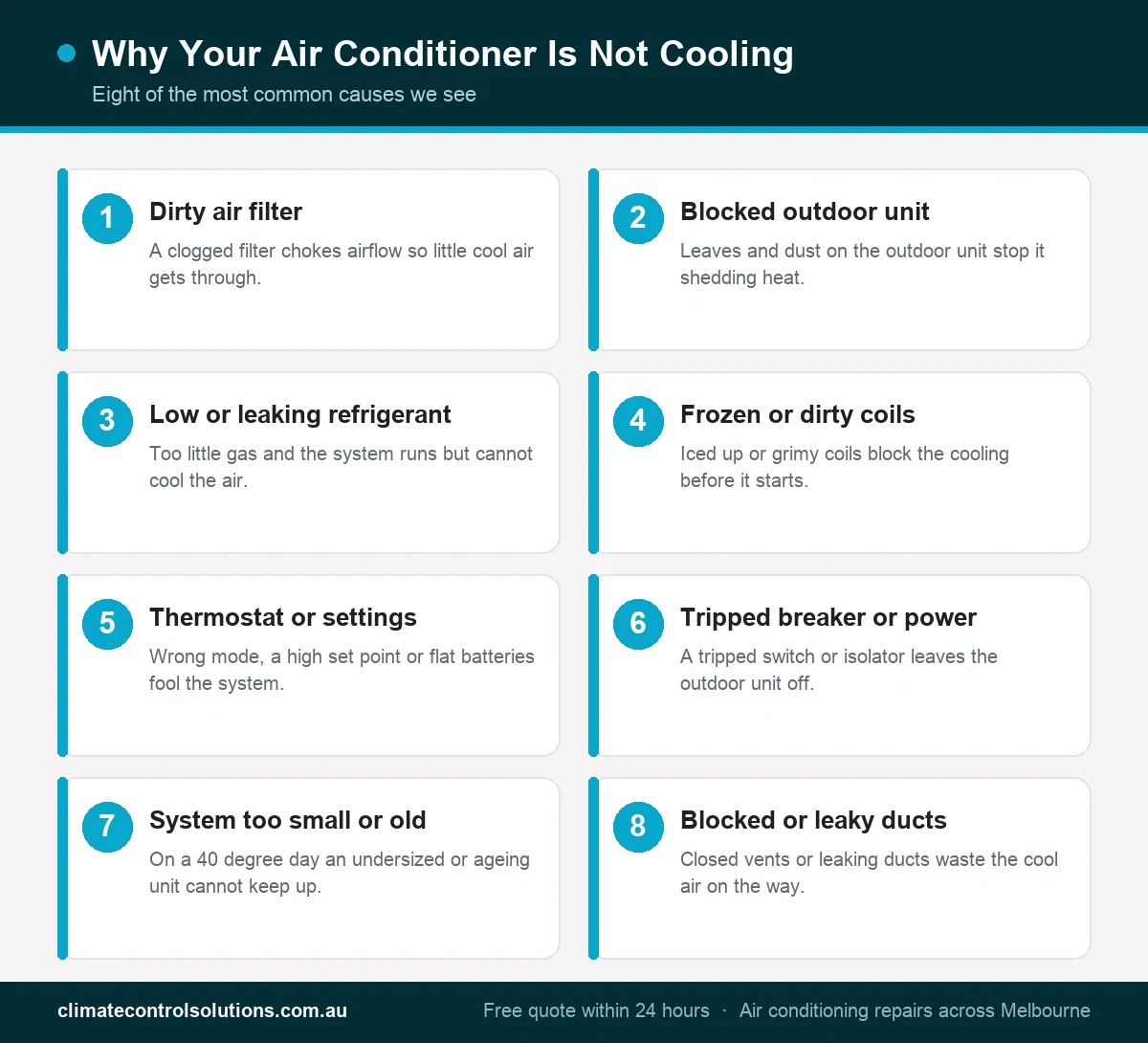
If you have done the quick checks and the unit is still not cooling, the fault is likely inside the system itself. Here is what we see most often, what it looks like, and what it means for you.
A dirty air filter
We mentioned it in the quick checks, but it deserves a proper mention because it is the number one cause of an air conditioner running but not cooling. When the filter is clogged, the indoor unit cannot pull enough warm air across the coils to transfer heat. The evaporator coil gets too cold, ice forms, and the airflow drops off a cliff. You end up with a system that runs constantly, uses plenty of power, and produces barely a whisper of cool air. If your filter is dusty, clean it now and see if the cooling improves within half an hour.
A blocked or dirty outdoor unit
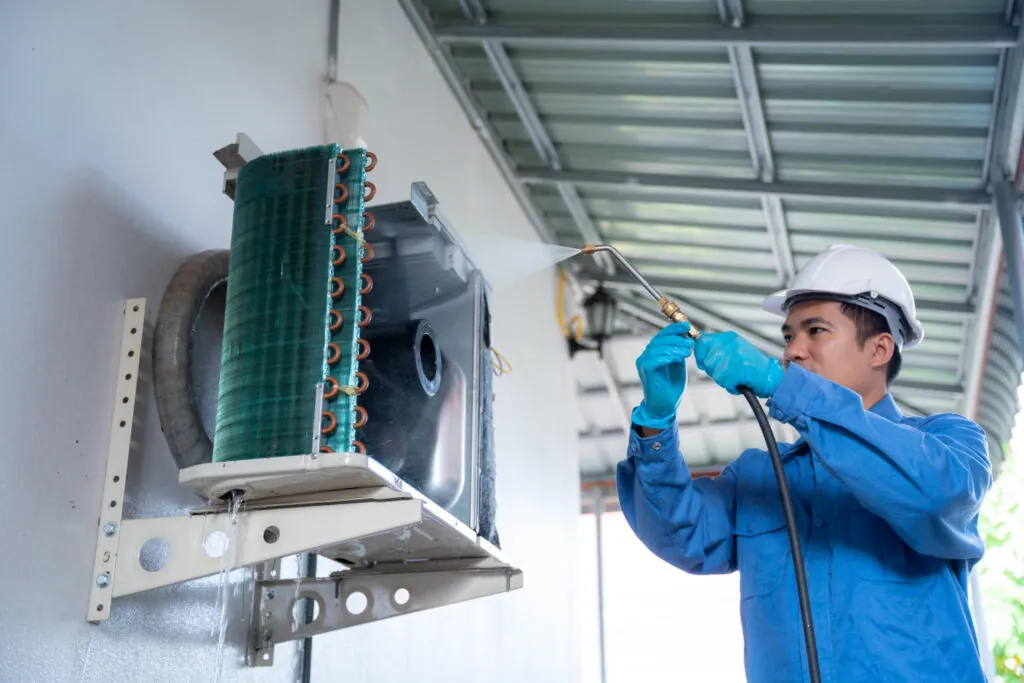
The outdoor unit is where your air conditioner dumps the heat it pulls from inside your home. If the coil fins on the outside are clogged with cottonwood, dust, or that fine grey grime that builds up in Melbourne, the heat has nowhere to go. The system runs, but it cannot reject the heat, so the indoor temperature stays put. Take a look at the coil through the grille. If it looks furry, a gentle rinse with a hose from the inside out can help, but be careful not to bend the fins. If it is badly caked on, a professional clean is the right call.
Low or leaking refrigerant
This is the big one. If your aircon is not blowing cold air and the air is just lukewarm, low refrigerant is a very likely culprit. Refrigerant is the lifeblood of the system, and it does not get consumed over time. If the level is low, you have a leak somewhere in the copper lines. A slow leak means a gradual drop in cooling over months, while a fast leak can take the system from icy cold to nothing in a day. You might also notice ice building up on the copper pipes at the outdoor unit. Do not try to top it up yourself. Handling refrigerant requires an ARC licence, and adding gas without finding and fixing the leak is just a waste of money. It will leak out again.
Frozen or dirty coils
If you open the indoor unit and see ice on the coil, or if the unit is blowing air that is barely cold before turning into a dribble of water, you have a frozen coil. This is usually caused by restricted airflow, often from that dirty filter we keep talking about, or a failing fan motor. It can also be caused by low refrigerant, which makes the coil too cold and causes condensation to freeze on contact. Turn the system off and let it thaw out completely, which can take a few hours, before you do anything else. Running it while frozen will only make it worse. If the melt is overflowing onto the floor, our guide to an air conditioner leaking water inside covers the drain side of the problem.
The thermostat and settings
Sometimes the problem is not the machine, it is the controls. If the thermostat is in a spot that gets direct sunlight, or it is placed near a heat source like a TV or an oven, it will read the room temperature as warmer than it actually is. The unit will run longer than it needs to, and the room might feel fine but the unit never switches off. Conversely, if the thermostat is in a cold draft, it can switch off before the rest of the room catches up. Make sure the thermostat is set to cool, not fan or dry mode, and check that the fan setting is on auto rather than low, which can cause the coil to ice up on humid days.
A tripped breaker or power fault
A tripped breaker is a classic cause of a split system that has stopped cooling. The indoor unit might still run off a different circuit, or the display might be on, but the outdoor compressor has no power. If the breaker has tripped, reset it. If it trips again immediately, or after a few minutes of running, do not keep resetting it. That is a sign of a short circuit or a failing compressor, and it is a job for an electrician. Similarly, if the outdoor unit is humming but the fan is not spinning, the fan motor capacitor is likely dead. That is a straightforward part for a technician to replace, but it is not a DIY job.
The system is too small or too old for the heat
Here is the hard truth we have to deliver more often than we would like. If your system is running fine, blowing cold air, but the room is just not getting cool enough, your air conditioner might be undersized for the space. This is especially common in Melbourne, where older homes have had extensions added or rooms opened up without upgrading the cooling. On a 40-degree day, a system that was fine for a 20-square-metre room is not going to cope with a 35-square-metre open plan area. Age also plays a part. An older unit loses efficiency every year, and after 10 to 15 years, it simply cannot produce the same cooling capacity it did when it was new. If it has genuinely reached that point, our guide to the best air conditioner brands and the cost of a new split system will help you plan the replacement.
Blocked or leaking ducts and vents
This one applies if you have a ducted system rather than a split system. If the air blowing out of some vents is cold but others are just warm, or if you can hear a whistling sound when the unit is running, you likely have a duct leak or a blockage. Rodents, dust, and even old tape can cause ducts to come apart or collapse. The system itself might be working perfectly, but the cooled air is being dumped into your roof cavity instead of the living room. A technician can test the airflow and find the problem, but it is not something you can easily see or fix yourself without crawling around a dark, dusty ceiling.
What you can fix yourself, and what needs a technician
We are not here to sell you a service you do not need, but we are also not going to let you do something dangerous. The line between a DIY fix and a licensed job is clear, and crossing it is illegal, unsafe, and will void your warranty. Here is the breakdown.
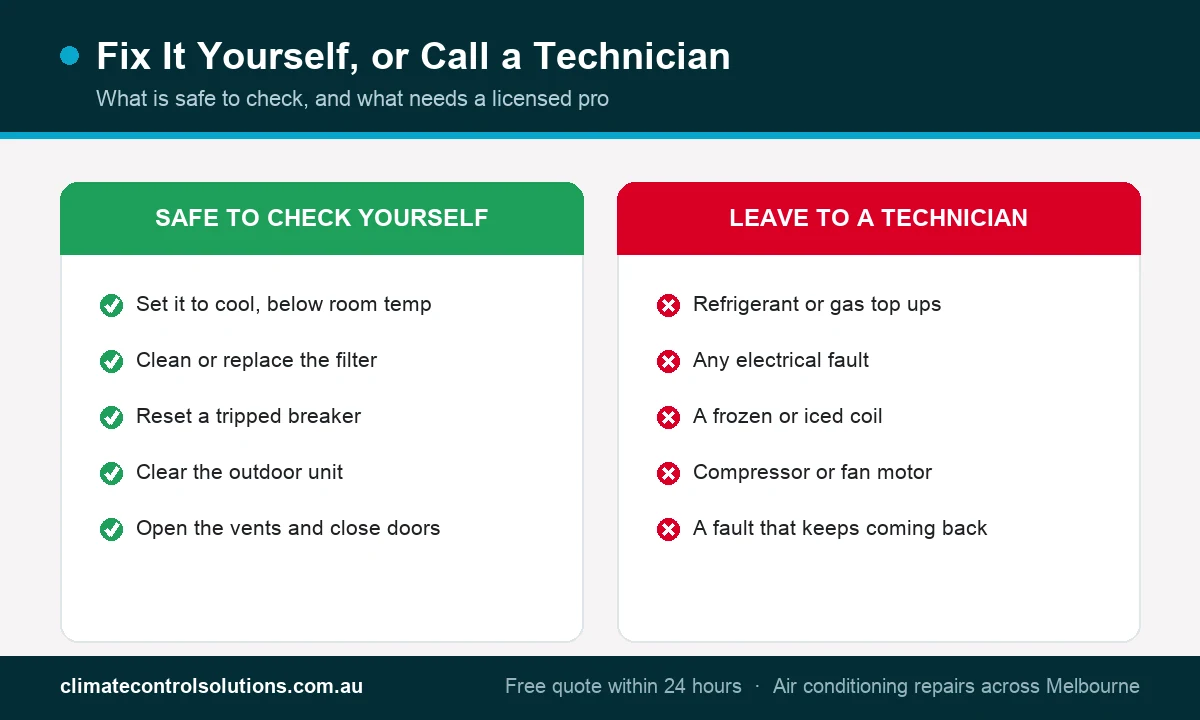
Safe to check and fix yourself: cleaning or replacing the air filter, clearing leaves and debris from around the outdoor unit, checking and resetting a tripped breaker, changing the batteries in a wireless thermostat, and making sure vents are open and unobstructed.
Leave to a licensed technician: any work involving refrigerant, including checking pressures and recharging gas. Also leave any electrical work to a licensed electrician, which includes replacing capacitors, contactors, or wiring. If you open up the electrical panel on the outdoor unit, you are dealing with mains voltage, and that is not a place to learn. Duct cleaning and repairs also need professional equipment to do properly.
If you have done the basic checks and the unit is still not cooling, call a professional. We have seen too many people make a small problem worse by poking around inside the electrical compartment or trying to add refrigerant from a can bought online. It is not worth the risk.
How to stop it happening again
The best fix is the one you never need. A little bit of routine care goes a long way in Melbourne’s climate.
Clean or replace the indoor air filter every one to three months, depending on how much dust you have in the house. If you have pets, clean it monthly.
Book an air conditioner service before summer, not during it. A technician will check the refrigerant levels, clean the coils, check the electrical connections, and make sure the system is running at peak efficiency. It is much cheaper than a breakdown callout on a 38-degree Saturday.
Keep the outdoor unit clear of leaves, grass, and anything else that blocks airflow. A quick sweep once a month is all it takes.
Melbourne heatwaves and your air conditioner
There is a difference between a fault and a system that is simply out of its depth. On a 40-degree Melbourne day, even a healthy system can struggle if it is undersized for the space or if the house is not sealed properly. If the unit is blowing cold air, but the room just cannot get below 28 degrees, the system is working as hard as it can. It is not broken, it is just overwhelmed. If it gives out in the middle of a heatwave, we also handle emergency air conditioning repairs across Melbourne.
However, if the unit is blowing warm air, or if it is cycling on and off constantly without producing cold air, that is a fault, and waiting it out is not an option. If you have done the quick checks and nothing has changed, it is worth calling someone rather than waiting. The longer a system runs on low refrigerant or with a faulty component, the more damage it does to the compressor, and that is the most expensive part of the whole unit to replace. Our air conditioning repairs team sees this every summer, and a quick call early on can save you from a full replacement later. If you are not sure whether the issue is the unit or the heat, call and ask. We would rather talk you through it than have you swelter for a week. We cover across Melbourne and the surrounding suburbs, and a regular service is the single best way to avoid the problem in the first place. And for those cold winter months when the same system is blowing lukewarm air, that is a different problem entirely, and you can read about a heater blowing cold air in our guide to that.
Frequently asked questions
Why is my air conditioner running but not cooling?
The most likely cause is a blocked filter or a dirty condenser coil, which stops the unit from moving heat the way it should. If the filter is clean and the outdoor coil is clear, check the thermostat settings and the fan speed. When those are all fine, the issue is usually refrigerant related, and that is a job for a licensed technician.
Why is my air conditioner blowing warm air instead of cold?
Warm air usually means the compressor is not running, or the refrigerant has leaked out to a level where the system cannot cool at all. You might hear the compressor hum but not stay on, which points to a failing run capacitor or a faulty compressor. Do not keep flipping the unit on and off to try to force it, that can cause more damage.
Why is my split system not cooling when the fan is still running?
The fan running while the compressor is silent tells you the electrical supply is reaching the indoor unit, but the cooling part has stopped. A tripped breaker, a failed capacitor, or a compressor that has overheated are all common causes. If the outdoor unit is running and the indoor fan is blowing warm, check the filter first, then call us to check the refrigerant charge.
Can low refrigerant stop an air conditioner from cooling?
Yes, low refrigerant will stop an air conditioner from cooling, because the system needs the right amount to absorb heat from your room and dump it outside. Low refrigerant is almost always a leak, not a natural loss, so topping it up without finding the leak is a waste of money. A licensed technician can locate the leak, repair it, and recharge the system properly.
Why is my air conditioner not cooling on a really hot day?
On a 40-degree day, your air conditioner has to work harder to push heat out of the house, and if the condenser coil is dirty or the unit is undersized, it will struggle. It may also trip its own safety switch to protect the compressor from overheating. Keep the outdoor unit shaded and clean, but if it still cannot keep up, the system may need a service or an upgrade.
How long should an air conditioner take to cool a room?
A properly sized split system should noticeably cool a room within 10 to 15 minutes, and reach your set temperature in about 30 minutes on a normal day. If it is blowing cold but the room is not dropping, the filter is dirty or the unit is too small for the space. On an extreme heatwave day, add a bit more time, but it should still make progress, not just blow lukewarm air.
How much does it cost to fix an air conditioner that is not cooling?
The cost depends entirely on the fault, from a simple filter clean or capacitor replacement to a refrigerant leak repair or a new compressor. A service call fee covers the diagnosis, and then you will get a quote before any work starts. We always recommend getting a clear quote up front, so you are not left guessing.
Should I keep running an air conditioner that is not cooling?
No, do not keep running an air conditioner that is not cooling, because it can freeze the evaporator coil or overheat the compressor. That turns a simple fix into an expensive one. Turn it off, check the filter and thermostat, and if it still is not cooling, call a licensed technician to take a look.
Air conditioner still not cooling?
If the quick checks have not fixed it, our licensed technicians can find the fault fast, with fixed upfront pricing and same-day options across Melbourne. Book a repair and we will get back to you within 24 hours.