



You do not need an air purifier in every bedroom. A properly sized HEPA purifier can reduce airborne dust and other particles, which makes it worth considering when those exposures are a concern. It will not clean your mattress, remove settled dust or replace asthma treatment.
Before buying an air purifier for bedroom dust, decide what you want it to change: particles floating in the air, dust collecting on furniture, or symptoms that need medical advice. Those are different problems. Spending more on a purifier does not make it the right answer to all three.
Do Air Purifiers Help With Bedroom Dust?
Yes, they can capture particles suspended in the air that passes through their filters. Dust already sitting on a shelf, in carpet or in bedding still needs cleaning.
Think about the result you would consider useful. If you expect never to dust the bedside table again, keep your money. If your aim is to reduce airborne particles in the room where you sleep, a suitable purifier has a clearer job.
| Your main concern | What filtration can contribute | What still needs attention |
|---|---|---|
| Airborne dust, pollen or pet particles | A particle filter can capture some of what reaches it. | The source, room cleaning and relevant trigger advice. |
| Dust on surfaces and bedding | It cannot clean those surfaces. | Dusting, vacuuming and bedding care. |
| Asthma or allergy symptoms | Reducing exposure may help some people. | Your clinical assessment and treatment plan. |
| A damp or mouldy bedroom | Filtering particles does not repair dampness. | Find and resolve the moisture source. |
The US EPA’s home filtration overview places filtration alongside removing pollution sources and ventilation with clean outdoor air. It also explains that a portable purifier serves a room or area, rather than automatically cleaning an entire home.
Can a Bedroom Air Purifier Help With Asthma or Allergies?
It may help reduce exposure to airborne triggers, but cleaner air is not a guaranteed improvement in symptoms. Your triggers, other exposures and treatment all matter.
Asthma Australia’s purifier guidance describes HEPA filtration as one measure to consider for reducing exposure. It does not endorse a particular appliance as the answer for everyone with asthma.
Do not reduce or stop prescribed treatment because you bought a purifier or because its air-quality light turns green. Discuss treatment changes with your clinician.
If coughing, wheezing or breathlessness is waking you, book a medical review rather than waiting to see whether a purchase fixes it. The National Asthma Council’s sleep guidance says night-time symptoms should not be accepted as normal. That distinction matters: an appliance decision should not delay a conversation about asthma control.
Will It Remove Dust Mites From the Bed?
No. Air filtration does not remove a dust-mite reservoir from your mattress or pillows. Dust mites live in soft furnishings, and managing a confirmed allergy requires attention to those materials.
ASCIA’s allergen minimisation guidance recommends measures such as washing bedding weekly in water hotter than 60°C and considering mite-resistant covers for mattresses and pillows. Follow fabric-care instructions and ask your clinician which measures suit your situation.
Use a damp cloth for settled dust and keep up regular vacuuming. Vacuuming can temporarily stir allergens into the air, so a person affected by them should avoid doing that job where possible. A purifier does not make bedding care optional.
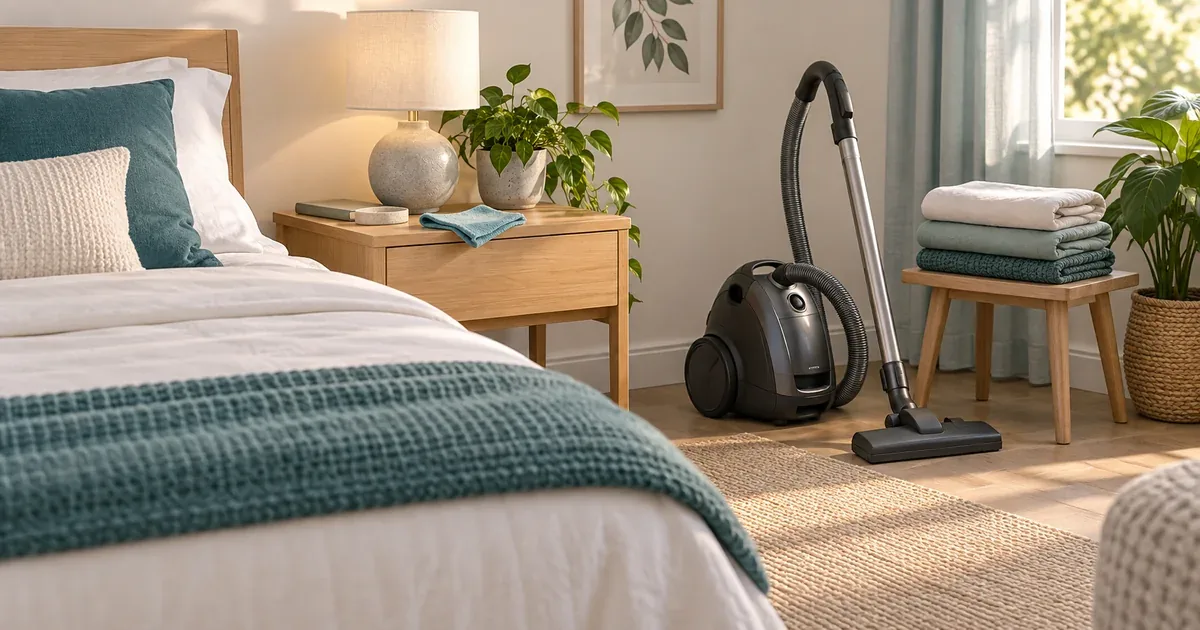
When comparing products, separate “captures airborne allergens” from “removes dust mites from bedding”. Those claims describe different jobs. Ask the seller to explain exactly what its product has been tested to do.
What Size Air Purifier Does Your Bedroom Need?
Look for the clean air delivery rate, or CADR, in cubic metres per hour. It describes particle-cleaning capacity; it is different from a filter’s capture percentage and from an air conditioner’s kW rating.
The Victorian Government’s sizing guide gives room-based CADR values using a 2.4-metre ceiling. Its figures correspond to about five equivalent room volumes of clean air per hour. That is a practical sizing reference, not a prescribed asthma treatment or a promise to remove every particle.
| Room dimensions | Room volume | CADR at Five Room Volumes per Hour |
|---|---|---|
| 3 m × 3 m | 21.6 m³ | 108 m³/h |
| 3 m × 4 m | 28.8 m³ | 144 m³/h |
| 4 m × 4 m | 38.4 m³ | 192 m³/h |
| 4 m × 5 m | 48 m³ | 240 m³/h |
These are calculated examples: length × width × ceiling height × 5. A higher ceiling or a larger connected space increases the volume to consider. They are not measurements of a particular bedroom or purifier.
Write down your room dimensions before comparing products. Then ask which fan setting delivers the quoted CADR. If the supplier gives only a headline “covers up to” floor area, ask what ceiling height and cleaning rate that assumes.
Check the Setting You Can Sleep With
A purifier that is too noisy to leave on is a poor fit for a bedroom. Compare airflow and sound at the same operating setting, not maximum airflow against minimum noise.
The EPA’s consumer air-cleaner guide notes that CADR is usually measured at maximum speed and that lower speeds filter less air. It also reports that improvements in asthma or allergy symptoms vary between studies. A room-size claim is not a health-outcome claim.
Before choosing a model, ask:
- What is the CADR at the quiet setting I would use overnight?
- Can I dim or switch off the display lights?
- What do replacement filters cost, and are they available in Australia?
- Which parts are washable, and which filters must be replaced?
- Does it intentionally generate ozone? Avoid an ozone-generating purifier; ozone irritates the lungs.
A stated HEPA filter and usable airflow figures are more helpful than vague “wellness” promises. Do not buy solely because a listing claims an impressive particle-capture percentage. Air still has to reach the filter.
Where Should You Put an Air Purifier in a Bedroom?
Put it where air can enter and leave freely. Follow the model’s clearance instructions, as Carrier’s placement guidance advises, keep it clear of curtains and furniture, and avoid an outlet blowing uncomfortably towards your face.
There is no single bedside distance that suits every design. A purifier tucked behind the bed or beneath a crowded table may look tidier, but blocked airflow defeats the purpose. Check the actual dimensions against the floor space before ordering.
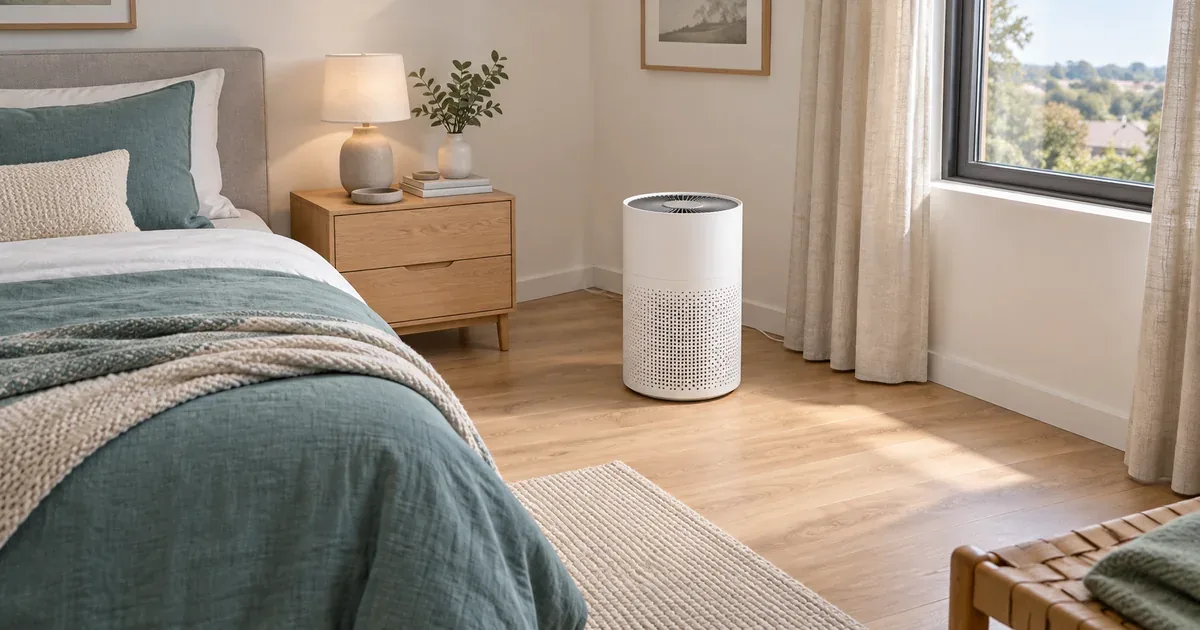
For overnight use, choose a model intended for that operation and follow its manual. Leave the air openings clear and keep the lead away from walkways. Do not put a floor-standing appliance on an unstable bedside table to get it closer to your pillow.
An open bedroom door connects the room to more of the home, so a bedroom-only size estimate becomes less representative. But closing a door does not remove the need for ventilation. A standard HEPA purifier does not supply fresh air or remove exhaled carbon dioxide. Plan ventilation around outdoor conditions rather than sealing the room indefinitely.
During bushfire smoke, follow local health advice. NSW Health’s smoke guidance includes reducing smoke entry and considering HEPA filtration. Reopen the home when conditions and local advice support it; the purifier is one part of that response.
Is Your Air Conditioner Already Doing This Job?
Do not assume a standard split system is equivalent to a dedicated HEPA purifier. Its primary job is heating and cooling; filtration capability depends on the model.
If temperature is the problem, split system air conditioning addresses a different need from particle filtration. Some air conditioners have additional filtration features, but compare their documented capability rather than treating every mesh filter as HEPA.
Keep the existing system’s filters maintained. Our air conditioner servicing guide explains routine care. If the unit has an unresolved smell, drainage problem or poor airflow, arrange air conditioning servicing in Melbourne rather than using a purifier to hide the symptom.
Water coming from the indoor unit needs its own investigation; see our air conditioner leaking water guide. If you have evaporative cooling, its airflow and water use are different again. Our evaporative and refrigerated cooling comparison helps distinguish the systems.
What to Decide Before Spending Money
Start with one bedroom and a clear purpose. Measure it, check where the appliance will fit, compare the quiet-setting airflow and price the replacement filters. Keep the model manual and filter part number somewhere easy to find.
If you are buying because of symptoms, discuss those symptoms and likely triggers with a clinician. If you are buying because the room collects dust, keep the cleaning routine. A purifier should have a specific job you can explain before you pay for it.
If the air conditioner smells musty, our air conditioner odour guide explains what to check and what to tell the technician.
Need Help With the Bedroom Air Conditioner?
Climate Control Solutions can help with residential air conditioning in Melbourne. For asthma symptoms or changes to medicines, speak with your healthcare professional.
Bedroom Air Purifier Questions
Do air purifiers help with dust?
They can capture airborne particles that pass through the filter. They cannot remove dust already resting on furniture or in bedding, so cleaning still matters.
Do air purifiers help asthma?
Reducing exposure to airborne triggers may help some people, but symptom improvement is not guaranteed. Use filtration alongside your asthma care plan, not instead of it.
Where should I put an air purifier in my bedroom?
Choose a stable position with clear airflow and the space required by the manufacturer. Keep it away from curtains and do not hide it behind furniture.
Can you sleep with an air purifier on?
Choose a unit intended for overnight operation and follow its instructions. Check airflow at the quiet setting, keep its openings clear and avoid a trailing lead across the walkway.
Will an air purifier remove dust mites?
It does not remove dust mites from mattresses or bedding. If dust-mite allergy is confirmed, discuss bedding and other exposure-reduction measures with your clinician.