



Every Australian summer, the same question comes up in homes across the country: should you go with evaporative cooling or refrigerated? It feels like a simple either-or, but the honest answer is that one isn’t better than the other. The right choice comes down to your climate, and getting it wrong is something you feel (and pay for) every hot day.
This guide breaks down how each system actually works, what they cost to run, and how to pick the one that suits your home and your part of Australia. We install both across Melbourne, so we have no reason to push you one way or the other. We just want you to end up with the right system.
Evaporative cooling is cheaper to buy and run in hot, dry air, but it uses water, needs windows open, and only cools. Refrigerated cooling (split systems and reverse cycle) works anywhere including humidity, holds an exact temperature, uses no water, and reverse cycle heats in winter too. As a rule: dry inland climates suit evaporative, humid and coastal areas need refrigerated, and temperate cities like Melbourne can go either way.
How evaporative cooling works

Evaporative cooling uses a beautifully simple idea: water evaporating cools the air around it, the same way a sea breeze feels cooler than the beach. A unit on your roof draws in hot outside air, passes it through wet filter pads, and the evaporation drops the temperature before a fan pushes that cooler air through ducts into your rooms.
Because it constantly brings in fresh outside air, you run it with a few windows or doors cracked open, which lets the warm air escape. It works best when the air is dry, which is exactly why it is so popular across inland and southern Australia. You can read more on our evaporative cooling page.
How refrigerated cooling works
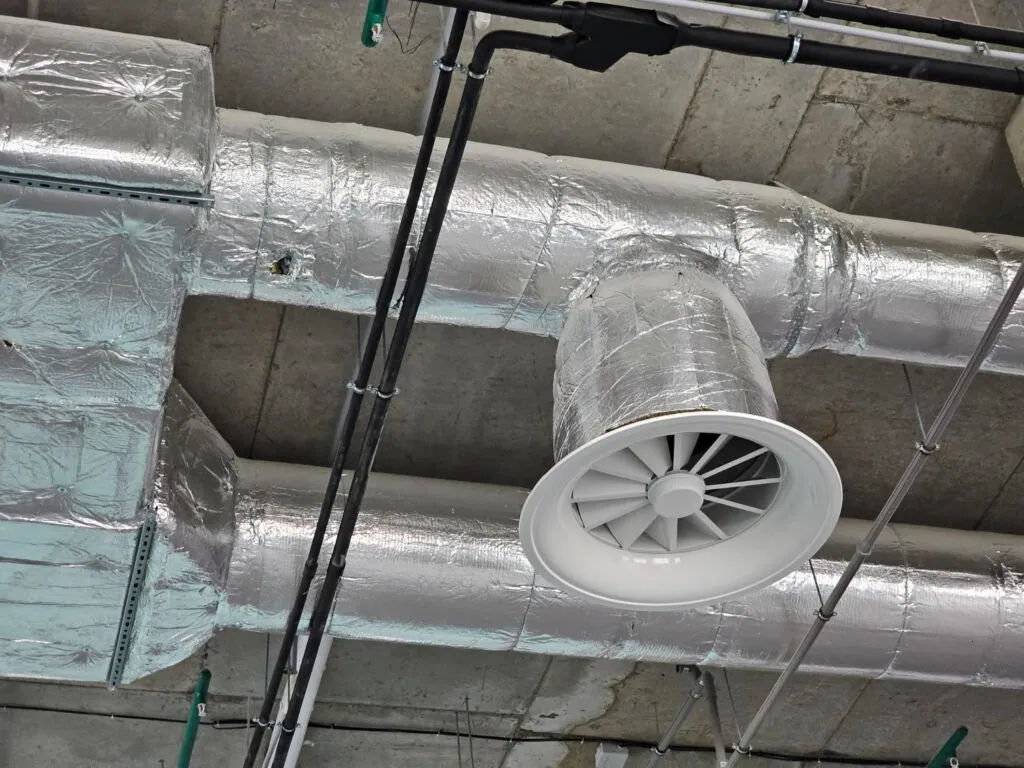
Refrigerated cooling works like your fridge. It pumps refrigerant through a cycle that pulls heat out of your home and dumps it outside, cooling and gently drying the air as it goes. Your split system and reverse cycle ducted systems are both refrigerated.
Unlike evaporative, it runs in a sealed home with the windows shut, and it holds whatever temperature you set no matter how hot or humid it is outside. The big bonus: a reverse cycle system runs the process backwards in winter to heat your home too, so one system covers the whole year.
The climate question: the one that really decides it
This is where most of the decision is made. Evaporative cooling depends on dry air to work, so its performance is tied directly to humidity. On a dry 38 degree day it is superb. On a muggy, humid day the air is already close to saturated, the evaporation slows right down, and the cooling fades just when you need it most. Refrigerated cooling does not care about humidity at all.
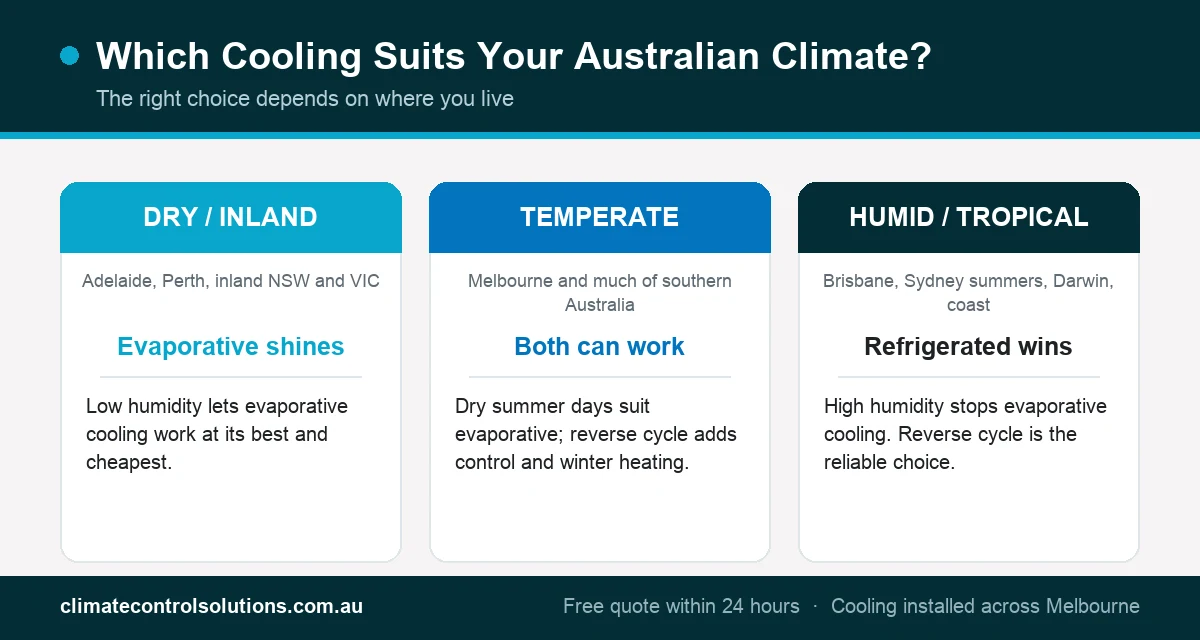
So the map does a lot of the deciding for you. Dry inland regions and cities like Adelaide and Perth are evaporative country. Humid and coastal areas, Brisbane summers, Sydney’s sticky spells and the tropical north, really need refrigerated. Melbourne and much of southern Australia sit in the middle, where summer days are often dry enough for evaporative but many homes still prefer refrigerated for the control and the winter heating.
Running costs and efficiency
Here is where evaporative earns its reputation. in dry heat it only runs a fan and a small water pump, so it sips electricity compared to a refrigerated system. The trade-off is that it uses water, and it cannot cool below what the conditions allow. Refrigerated cooling uses more power, but modern inverter units are efficient, and a reverse cycle system is also one of the cheapest ways to heat a home, which changes the whole-year maths.
| System | Runs on | Best climate | Heats too |
|---|---|---|---|
| Evaporative | Fan and water pump, low power, uses water | Hot and dry | No |
| Split system (refrigerated) | Electricity, efficient inverter | Any, including humid | Reverse cycle |
| Ducted reverse cycle | Electricity, whole home | Any, including humid | Yes |
If you are weighing up reverse cycle for its year-round value, our guide on running reverse cycle in Victoria digs into the heating side of the numbers.
Evaporative vs refrigerated at a glance
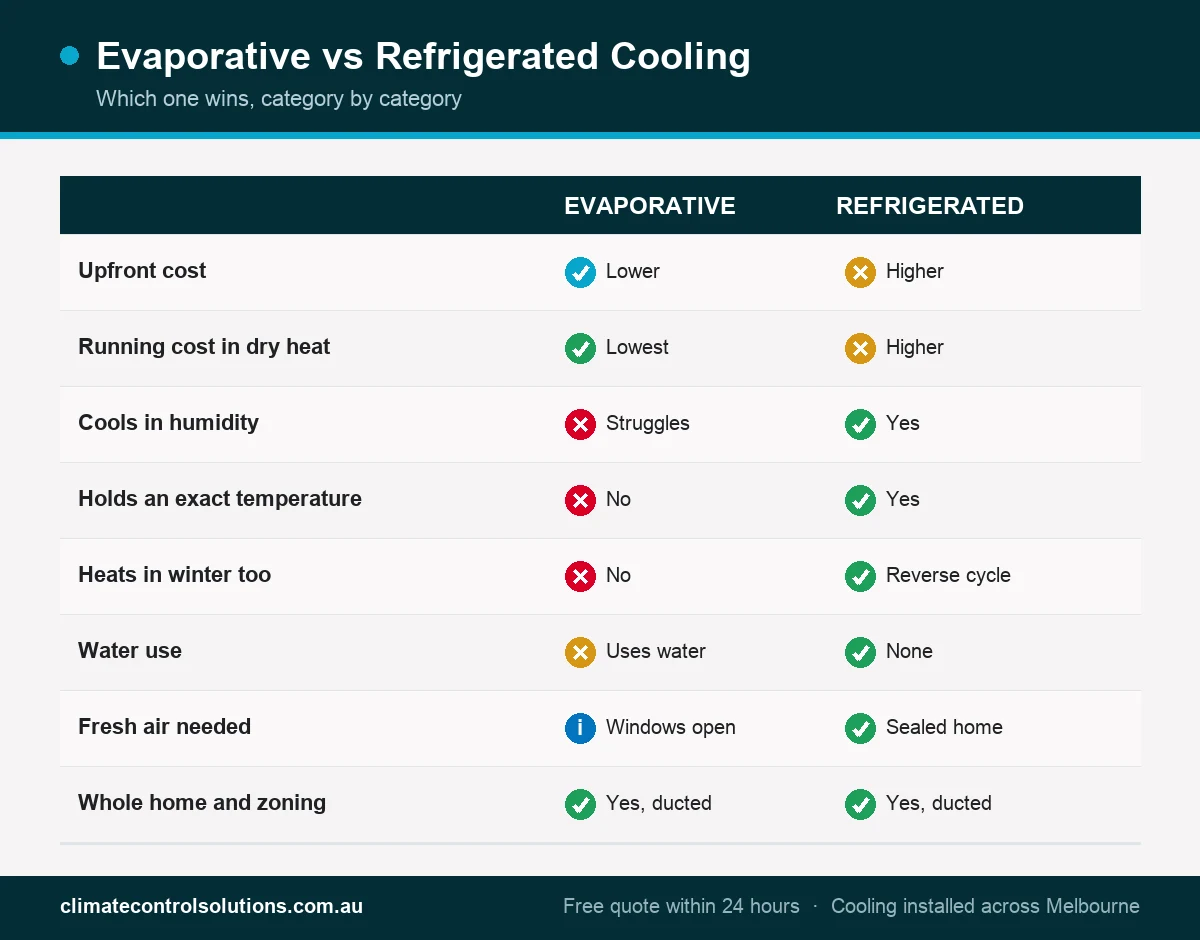
Water use and the environment
One factor that matters more in Australia than almost anywhere is water. Evaporative cooling uses water every hour it runs, which is worth thinking about during water restrictions or if you are on tank water. Refrigerated cooling uses no water, only electricity, and if you have solar you can run it through the middle of the day for very little. Neither is simply greener than the other. It depends on whether water or power is the scarcer resource where you live.
So which should you choose?
Strip away the detail and it comes down to a few honest questions about your home and your climate.
Choose evaporative if
You live somewhere hot and dry, you want low running costs and fresh air flowing through the house, and you already have a separate heater for winter.
Choose refrigerated if
You get humid or muggy days, you want an exact temperature in a sealed home, or you want the one system to cool in summer and heat in winter.
Choose ducted if
You want whole-home comfort with zoning, whether that is ducted evaporative in a dry climate or a reverse cycle ducted system for year-round control.
Still unsure?
A quick on-site assessment settles it fast. We look at your climate, home layout and how you use each room, then recommend the system that actually fits.
What this means for Melbourne homes
Melbourne is one of the trickier places to call, because our summers swing between dry northerly scorchers and the odd humid, sticky day. Evaporative cooling handles the dry days well and keeps running costs down. But a growing number of Melbourne homes choose reverse cycle refrigerated cooling, because it stays comfortable on every kind of day and doubles as efficient heating through our cold winters. The Victorian Energy Upgrades rebate can bring the cost of an efficient reverse cycle system down further.
If you want the flexibility of cooling several rooms independently, our multi-head split system guide is worth a look too.
Frequently asked questions
Is evaporative or refrigerated cooling better?
Neither is better outright. It depends on your climate. Evaporative cooling works best in hot, dry air and costs less to buy and run there. Refrigerated cooling (including split systems and reverse cycle) works in any conditions, including humidity, holds an exact temperature, and can heat in winter too. in dry inland Australia, evaporative is often ideal. in humid areas, refrigerated is the reliable choice. in temperate cities like Melbourne, both can work.
Does evaporative cooling work in humid weather?
Not well. Evaporative cooling relies on dry air to evaporate water and drop the temperature. When humidity is high, the air cannot absorb much more moisture, so the system struggles and can leave your home feeling damp. That is why evaporative cooling suits dry inland climates, while coastal and tropical areas are better served by refrigerated cooling.
Is evaporative cooling cheaper to run than refrigerated?
in hot, dry conditions, yes. Evaporative cooling only runs a fan and a small water pump, so it uses far less electricity than a refrigerated system, though it does use water. Refrigerated cooling uses more power, but modern inverter units are efficient and give you precise temperature control. If you live somewhere humid, evaporative is not a real option, so the running-cost comparison does not apply.
What is the difference between refrigerated and reverse cycle cooling?
They are the same cooling technology. Refrigerated cooling uses a refrigerant cycle, the same as a fridge, to remove heat from your home. A reverse cycle system is a refrigerated system that can also run in reverse to heat your home in winter. Split systems and reverse cycle ducted systems are both refrigerated. So reverse cycle simply means a refrigerated system that does heating as well as cooling.
Does evaporative cooling use a lot of water?
It uses water continuously while running, since cooling comes from evaporation. On a hot day an evaporative system can use a meaningful amount of water, which is worth considering during water restrictions or in drought-prone areas. Refrigerated cooling uses no water at all, only electricity, which you can offset with solar.
Can I heat my home with the same system that cools it?
Only with refrigerated reverse cycle systems. A reverse cycle split system or ducted system both cools in summer and heats in winter from the one unit, which is why so many Australian homes choose it. Evaporative cooling only cools, so you would still need a separate heater for winter.
Which cooling is best for a Melbourne home?
Both can work in Melbourne, because summer days here are often dry enough for evaporative cooling. That said, many Melbourne homes choose reverse cycle refrigerated cooling for its precise control, its performance on humid days, and the winter heating it provides from the same system. The Victorian Energy Upgrades rebate can also reduce the cost of an efficient reverse cycle system.
How much does each cooling system cost to install?
As a rough guide for a quality installed system, a single refrigerated split system runs about $2,500 to $5,000, ducted refrigerated or reverse cycle about $10,000 to $20,000, and whole-home ducted evaporative cooling about $3,000 to $6,000. Your home size, layout and system capacity all shift the figure, so the best step is a free on-site quote.
Not sure which cooling suits your home?
We install both evaporative and refrigerated cooling across Melbourne, so you get honest advice on which one fits your home and climate. Book a free on-site assessment and we will get back to you within 24 hours.
