



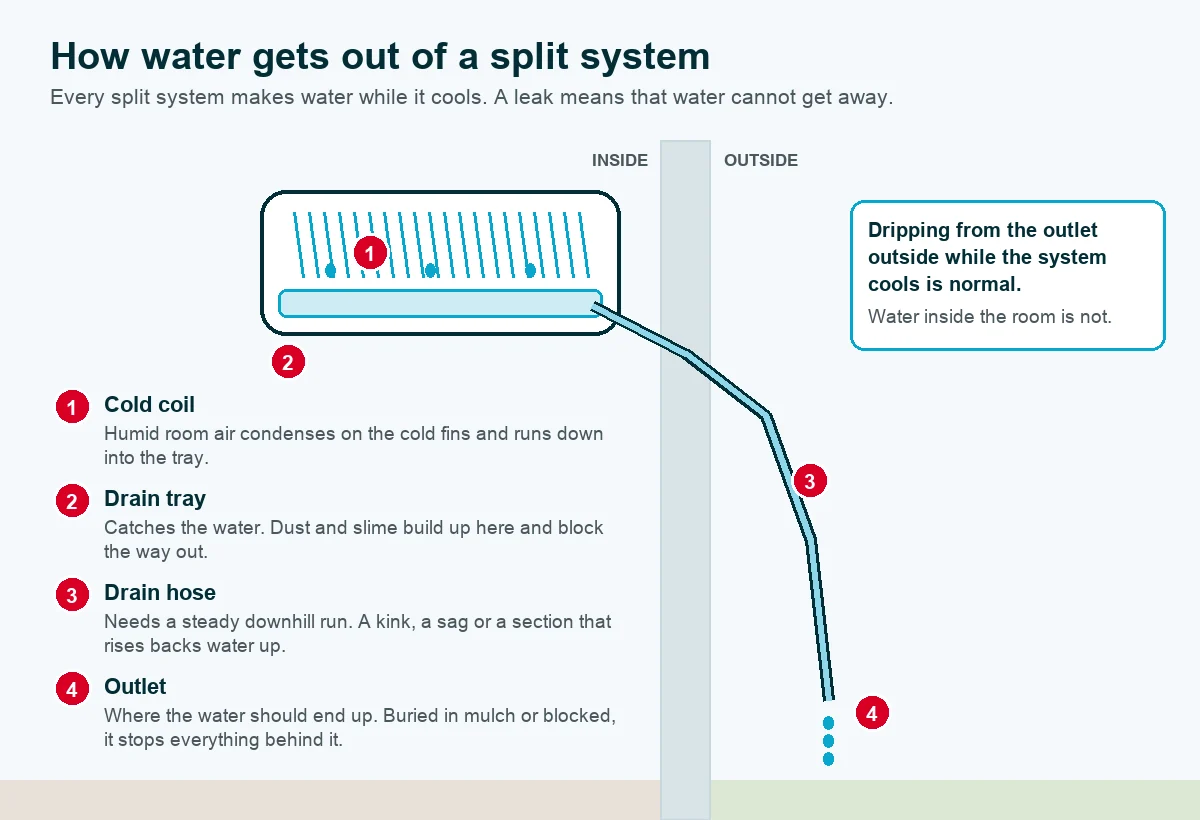
An air conditioner leaking water inside is usually a drainage problem, and usually a cheap one. Every split system pulls water out of the air while it cools. That water is meant to run into a tray, down a narrow hose and out through the wall. When it comes out of the indoor unit instead, something along that path has stopped it.
Water dripping from the indoor unit most often comes down to a blocked condensate drain, a drain hose that is kinked or no longer runs downhill, or a dirty filter that has let the coil ice over. Switch the system off, clean the filters, and check the end of the drain hose outside. If it still drips, clearing a blocked drain on a split system is typically $150 to $300 in Melbourne.
Where Is the Water Coming From?
Start with where the water actually is. It narrows things down faster than anything else, and two of these are not faults at all.
| Where you see water | What it usually means | Who sorts it |
|---|---|---|
| Dripping from the bottom or front of the indoor unit | A blocked drain tray or hose, a dirty filter, or an iced coil thawing | You first (filters), then a technician |
| Running down the wall below the unit | The drain hose has split, come loose or lost its fall behind the unit | A technician |
| A fine mist from the vent on a humid day | Normal. Cold air is meeting humid room air | Nobody |
| Dripping from the hose outlet outside while it cools | Normal. That is the drain doing its job | Nobody |
| A damp patch on the ceiling, or drips from a vent or return air grille | Ducted system: an overflowing drain tray or a failed condensate pump | Switch off, then a technician |
| Water leaking from an evaporative cooler | Usually the float valve or a tank seal | A technician |
The mist catches people out. Mitsubishi Electric’s operating manual for its MSZ-AP wall splits lists mist from the indoor unit’s outlet as expected behaviour: the cold air cools the moisture in the room so fast that it turns visible. Mist, fine. Drips, not fine.
Why a Split System Leaks Water Inside
A Blocked Drain Tray or Hose
This is the big one. Dust that gets past the filter lands in the tray, mixes with water and turns to slime, and a narrow drain hose does not need much slime to block. The same Mitsubishi Electric manual says it plainly: dirt or dust in the unit can clog the drain passage and cause water to leak from the indoor unit.
A partial blockage is sneaky. The system can drain fine on a mild day and overflow on a hot, humid one, because that is when it makes the most water. Which is why a drain that seemed fine all spring can let go in the first heatwave.
A Dirty Filter, and the Ice That Comes With It
Clogged filters choke the airflow over the coil. The coil gets cold enough to ice over, and when that ice melts, more water arrives at once than the tray can clear. Mitsubishi Electric recommends cleaning the filters on those wall splits every two weeks, and notes that dirty filters cause condensation inside the unit. If you are losing cooling as well, our guide to an air conditioner that is not cooling covers frozen coils in more depth.
The Drain Hose Has Lost Its Fall
Water only goes downhill. The hose has to fall the whole way from the unit to the outlet, and one sag, kink or section that rises is enough to back it up. Outside, the end of the hose gets buried in mulch, crushed behind a planter or left sitting in a puddle.
If the leak started straight after landscaping, painting or a new fence, look at the hose before anything else.
A New System That Drips
On a system only weeks or months old, suspect the install itself: a unit that is not quite level, or a drain run that does not fall properly. Call whoever installed it first, before you pay anyone else to look. If you want to know what a properly run drain is part of, our guide to split system installation in Melbourne walks through the job.
Humid Weather With the Doors Open
Run a split system for hours in very humid air with a door or window open and it can make more condensation than it can shed. Mitsubishi Electric’s manual warns against running its units for more than four hours at 80 percent humidity or above, or with windows and outside doors left open, because the water can drip and damage furniture. Shut the room up and it often stops by itself.
Low Refrigerant, the Other Kind of Leak
People use “leaking” for two different problems. A refrigerant leak does not put water on your floor directly, but it can let the coil ice up, and the melt drips exactly like a blocked drain. The giveaways are weak cooling and ice on the copper pipes. Topping up the gas is not a DIY job either. The Australian Refrigeration Council is clear that handling refrigerant without a Refrigerant Handling Licence is an offence. A licensed technician has to find and fix the leak, or the new gas simply leaks out again.
What You Can Safely Check in Ten Minutes
None of this needs tools, and none of it involves opening the unit.
- Switch the system off at the remote. If water is anywhere near a power point, a powerboard or anything electrical, turn it off at the isolator switch or the circuit breaker as well, and keep your hands off anything wet.
- Take the filters out and clean them. Vacuum or rinse, then dry them in the shade before they go back in.
- Find the end of the drain hose outside. Kinked, crushed, buried or sitting in water? Free it.
- Got a wet and dry vacuum? A minute of suction on the outside end of the hose can pull a partial blockage straight out.
- Run it on cool for half an hour with the doors shut, and watch.
What we would not do: poke wire up the drain from inside, take the casing off, or spray one of the foaming coil cleaners from the hardware store into the unit. Mitsubishi Electric’s manual warns that unsuitable detergent can damage the plastic inside the unit and cause water leakage, which is an expensive way to turn a small leak into a bigger one.
Switch It Off and Leave It Off If
Water is dripping onto a power point, a powerboard or other electrics, a ceiling stain is spreading or the plaster is sagging, or you can see ice on the pipes. Mitsubishi Electric’s advice for any abnormal condition is to stop the air conditioner immediately and get it looked at. A wet ceiling that is sagging can come down, so keep people out from under it.
Ducted and Evaporative Systems Leak Differently
A ducted unit lives in the roof, so a drainage fault shows up as a ceiling problem rather than a puddle under a wall unit. Many ducted indoor units lift their condensation away with a small pump. On Mitsubishi Electric’s PEAD-M ducted series, for example, the drain pump comes standard and lifts water up to 700 mm, and its whole job is to stop pooling, leakage and water damage. When that pump fails, or the tray under the coil overflows, the water has nowhere to go but the ceiling.
The first sign is often a brown stain near a vent or the return air grille, or drips from the grille itself. Turn the system off at the controller and book it in. Ducted leaks get quoted once the fault is found, because a failed pump and a blocked tray are very different jobs.
Evaporative coolers are the odd one out, because they are supposed to use water. A leak there is normally the float valve that controls the water level, or a tank seal. If you are still deciding on an evaporative cooling system, our comparison of evaporative vs refrigerated cooling sets out the trade offs.
What It Costs to Fix an Air Conditioner Leaking Water in Melbourne
These are indicative Melbourne ranges from our air conditioner repair cost calculator, not a quote. The real figure depends on what the technician finds.
| What needs doing | Typical cost |
|---|---|
| Diagnostic call out | $90 to $150 |
| Clearing a blocked condensate drain, split system | $150 to $300 |
| Float valve or tank seal, evaporative cooler | $150 to $350 |
| Regas, split system | $200 to $450 |
| Finding and fixing the refrigerant leak first | add $300 to $700 |
| Split system service, drain clearing included | $150 to $250 |
Compare the drain clear with the service at the bottom. If your split system has gone more than a year without a service and the drain is the problem, book the service instead. The price sits in the same range, and a service clears the drain as well as cleaning the filters and coil and checking the refrigerant pressures.

A diagnostic call out is usually credited toward the repair if you go ahead, so ask about that when you book. Our air conditioning repairs team quotes the fix before any work starts.
How to Stop It Coming Back
Filters are the part you control. Our guide to servicing your air conditioner suggests checking them every one to three months in normal use, and more often during a heavy summer. Once the system is running most days, Mitsubishi Electric’s two week recommendation is the one we would follow. It takes five minutes.
Then get the drain cleared before summer rather than during it. Melbourne searches for leaking air conditioners run at around 70 a month in September and climb to about 2,490 in January, going by Google Keyword Planner across the common ways people phrase it. A drain cleared in October is one you are not chasing in the middle of a January heatwave, and a yearly air conditioning service covers it.
And keep the outside end of the hose clear of garden beds, mulch and pot plants. That one costs nothing.
Great job done by Akila and the team. Have used many times now and would not go elsewhere. Great communication, prompt, and good workmanship.
Phil Pitt, Google review, March 2026
Still Dripping After Those Checks?
Our licensed technicians find where the water is coming from and quote the fix before any work starts.
Frequently Asked Questions
Why is my air conditioner leaking water inside?
Most often the condensate drain is blocked with dust and slime, the drain hose is kinked or no longer runs downhill, or a dirty filter has let the coil ice over and the melt is overflowing the tray. Running the system for hours in very humid air with doors or windows open can also make it drip. Clean the filters and check the hose outlet outside before you book anyone.
Is it normal for an air conditioner to drip water outside?
Yes. Water dripping from the end of the drain hose outside while the system cools is the drain doing its job. A reverse cycle outdoor unit also drips in heating mode when it defrosts. Water inside the room is the part that is not normal.
Can I keep using my air conditioner if it is leaking water?
We would not. Mitsubishi Electric’s advice for any abnormal condition is to stop the air conditioner straight away and have it checked, and water near electrics or soaking into a ceiling does real damage. Switch it off, do the filter and hose checks, and only run it again once the dripping has stopped.
How much does it cost to fix an air conditioner leaking water in Melbourne?
Clearing a blocked condensate drain on a split system is typically $150 to $300, plus a diagnostic call out of around $90 to $150 that is usually credited toward the repair. An evaporative cooler float valve or tank seal is around $150 to $350. If the cause turns out to be low refrigerant, allow $200 to $450 for the regas plus $300 to $700 to find and fix the leak. These are indicative ranges, not a quote.
Why is water coming through my ceiling from the ducted air conditioning?
A ducted indoor unit sits in the roof, often with a small pump that lifts the condensation away. If that pump fails or the drain tray overflows, the water ends up in the ceiling, usually as a stain or drips near a vent or the return air grille. Turn the system off, book a technician, and keep people out from under any plaster that is sagging.
Can low refrigerant make an air conditioner leak water?
Indirectly, yes. Low refrigerant can let the indoor coil freeze, and when that ice melts it can overflow the drain tray. You will usually notice weaker cooling as well. Refrigerant work needs a licensed technician, and a regas without fixing the actual leak will not last.
