



If you have started shopping for a new air conditioner in Australia, three names come up again and again: Daikin, Fujitsu and Mitsubishi. They are the brands installers trust and homeowners ask for by name. But which one is actually best for your home? That is the question this guide answers, honestly and without picking a favourite for the sake of it.
The truth is that no single brand wins for everyone. The best choice depends on your system type, room and property size, your heating and cooling needs, energy efficiency, noise, smart controls, budget, and, crucially, the quality of the installation. We install all three across Melbourne, so we have no reason to steer you one way. Let us compare them properly.
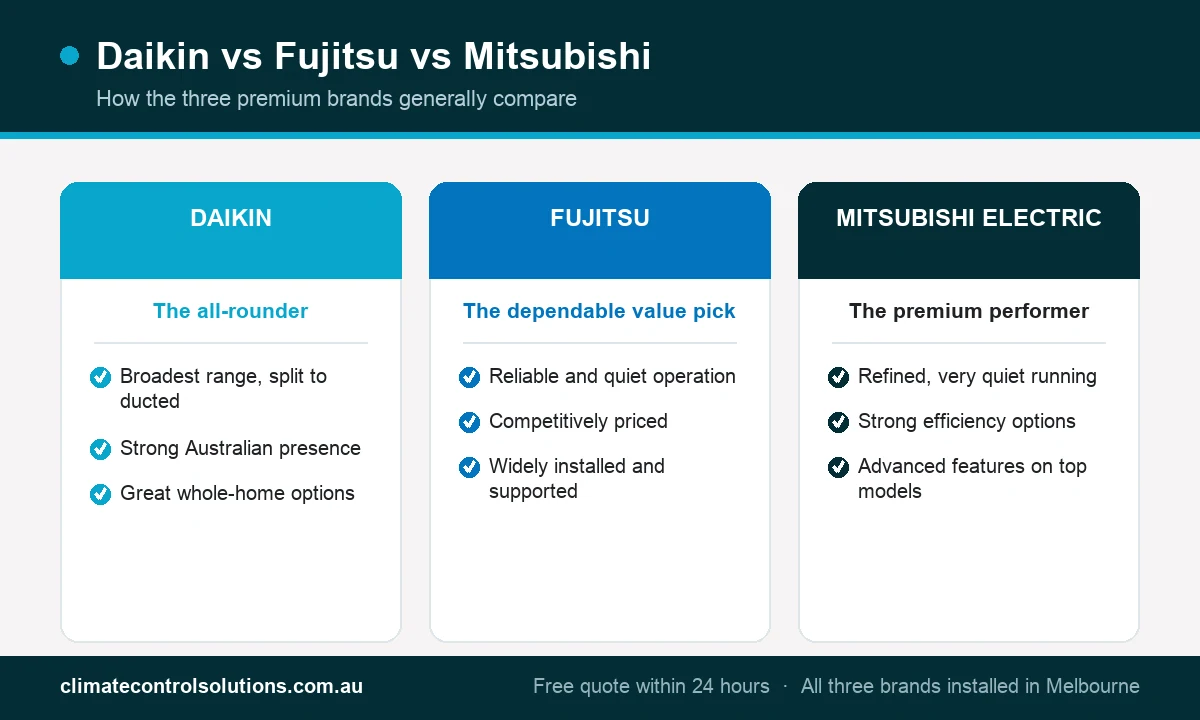
Daikin is a strong all-rounder with the broadest Australian range, Fujitsu is known for dependable, quiet performance at competitive value, and Mitsubishi Electric is chosen for premium efficiency, refined build quality and advanced features. That said, the model you pick, the sizing and the installation quality matter as much as the brand on the front.
Quick verdict: Daikin vs Fujitsu vs Mitsubishi
Here is the short version, category by category. Treat these as directions rather than absolute winners, because the exact model and a good install can change the outcome.
| Category | Which way it leans |
|---|---|
| Best overall | All three are excellent. Daikin and Mitsubishi Electric lead the premium end, so compare the exact models. |
| Best value | Fujitsu often gives the strongest price-to-performance for a trusted brand. |
| Best energy efficiency | Top Daikin and Mitsubishi Electric models rate very highly. Check the Zoned Energy Rating Label. |
| Best quiet bedroom | Mitsubishi Electric is renowned for very low indoor noise. Compare the model decibel rating. |
| Best for ducted | Daikin has one of the broadest ducted ranges, with Mitsubishi Electric close behind. |
| Best smart controls | All offer wifi. Check whether it is built in or an optional add-on for your model. |
| Best warranty and support | All three back residential systems with a strong five-year warranty and national support. |
| Best for Melbourne homes | Any reverse cycle model, sized for your home, with heating efficiency prioritised. |
Still deciding between Daikin, Fujitsu and Mitsubishi?
Daikin, Fujitsu and Mitsubishi at a glance
Daikin air conditioners
Daikin is one of the biggest names in air conditioning worldwide and has a huge presence in Australia. Its strength is range: whatever you need, from a single split system to a fully zoned ducted setup, Daikin has a model for it. That makes it a safe, flexible all-rounder for almost any property. The main thing to watch is that features and efficiency vary across the range, and some smart controls are optional, so compare the specific model rather than assuming every Daikin is premium.
Fujitsu air conditioners
Fujitsu General is one of the most widely installed brands in Australian homes, and it has earned that with dependable, quiet systems at a fair price. If you want a trusted name without the top-tier price tag, Fujitsu is often the sweet spot. Its range covers residential and light commercial needs well. Just check the details on smart features and wifi, which can be optional on some models, and confirm availability with your installer.
Mitsubishi Electric air conditioners
Mitsubishi Electric sits at the premium end and is chosen for refined, very quiet operation, strong efficiency and advanced features on its top models. It is a favourite for bedrooms and living spaces where low noise matters. As a Mitsubishi Electric Diamond Dealer, it is a brand we know especially well. The trade-off is price: equivalent models often cost more, and some smart controls add to that, so it is worth being sure you will use the extra capability.
Mitsubishi Electric is not Mitsubishi Heavy Industries.
These are two separate companies with different product ranges, warranties and installer networks. When you compare quotes or search for models, make sure you are looking at the same brand throughout, because mixing them up leads to confusing comparisons and the wrong expectations.
Daikin vs Fujitsu vs Mitsubishi comparison table
Here is a side-by-side view of how the three brands generally stack up. Use it as a starting point, then compare the actual models on your shortlist, since the specifics are what really decide it.
| Factor | Daikin | Fujitsu | Mitsubishi Electric |
|---|---|---|---|
| Market position | Broad, mainstream to premium | Dependable value | Premium |
| Split systems | Extensive range | Extensive range | Extensive range |
| Ducted systems | Very broad range | Solid range | Broad range |
| Energy efficiency | High on premium models | Good to high | High on premium models |
| Indoor noise | Low, very low on top models | Low, quiet models available | Very low, a noise leader |
| Outdoor noise | Low, install dependent | Low, install dependent | Low, install dependent |
| Smart controls | Wifi, built in or optional | Wifi, often optional | Wifi, built in or optional |
| Air filtration | Multiple filter options | Standard to fine filters | Advanced options on top models |
| Warranty | 5 years residential | 5 years residential | 5 years residential |
| Australian support | Strong national network | Strong national network | Strong national network |
| Price category | $$ to $$$ | $$ | $$$ |
| Best suited to | All-round and whole-home | Value and everyday use | Premium comfort and quiet |
Which brand offers the best cooling performance?
All three cool Australian homes well, because all three use efficient inverter technology that ramps up and down smoothly to hold a steady temperature rather than blasting on and off. in practice, the difference between a premium and a mid-range unit on a normal day is smaller than most people expect. What makes a far bigger difference is sizing. A properly sized mid-range system will comfortably outperform an oversized or undersized premium one, because the right capacity is what lets any of these brands maintain a stable, even temperature and good airflow through a long, hot spell.
For small rooms and bedrooms, a lower-capacity wall-mounted unit with a good minimum output and a quiet sleep mode is ideal, and all three do this well, with Mitsubishi Electric often the quietest. For large living and open-plan areas, you want a higher-capacity split with strong air throw, or a multi-split or ducted system to spread the air evenly.
Which is best for heating and Melbourne’s winter?
in Melbourne, heating is not an afterthought. Our winters are genuinely cold, so a reverse cycle system needs to heat efficiently for months, not just take the edge off. All three brands offer strong reverse cycle ranges that both cool in summer and heat in winter from the one system.
What matters is choosing a model with good heating performance and efficiency in cooler outdoor conditions, and sizing it for the home. For a household using the system year round, prioritise the heating star rating as much as the cooling one, since in Melbourne it will earn its keep in both seasons. Our guide on cooling types and the ducted reverse cycle option are both worth a look.
Which brand is the most energy efficient?
This is where brand-level claims can mislead, because efficiency varies a lot between model ranges and capacities. The most efficient systems across all three are the premium inverter models, and the top Daikin and Mitsubishi Electric units rate especially well. To compare fairly, do not trust a headline. Look at the Zoned Energy Rating Label and the cooling and heating star ratings for equivalent capacities in your climate zone. A model with more stars costs a little more upfront but less to run every year after that. Actual running costs also depend on your tariff, insulation, system size, how you use it and how well it is maintained, so keeping up with regular servicing matters too.
Daikin vs Fujitsu vs Mitsubishi noise levels
Noise is one of the most common real-world concerns, especially in bedrooms, apartments and townhouses. On the indoor side, Mitsubishi Electric is consistently among the quietest, with Daikin’s premium models close behind and Fujitsu offering quiet options too. For a bedroom, compare the lowest operating noise of the exact small-room models rather than trusting a brand-wide claim. On the outdoor side, the differences between brands are smaller than the difference a good install makes: placement, solid mounting and proper vibration isolation do more for real-world outdoor noise than the badge, which matters most where units sit close to a neighbour or a boundary.
Smart controls, wifi and user experience
All three brands offer wifi control and mobile apps, with scheduling, remote access and, on many models, energy monitoring and voice-assistant compatibility. The key differences are in the detail: whether wifi is built in or an optional add-on for your specific model, how good the app is, and which wall controllers and zone controls are available. Inverter systems generally perform best with the manufacturer’s approved controllers, so if smart control matters to you, confirm exactly what is included with the model you are quoted, rather than assuming, and check that the modes you want, such as a proper dry or dehumidification mode, are easy to reach.
Air filtration and indoor air quality
Each brand offers filtration features that range from washable filters through to finer particle and deodorising filters, and air-purifying options on some premium models, plus a dry mode for humidity. These are genuinely useful, but keep expectations realistic. An air conditioner with good filtration helps, but it is not a substitute for a dedicated air purifier or proper ventilation, and it is best not to buy on air-quality claims alone. If clean air is a priority, compare the actual filter type on the model and treat it as a helpful bonus rather than the deciding factor.
Reliability, lifespan and the installer
All three are established, reliable brands, and any of them can last well beyond a decade when chosen and cared for properly. Reliability comes down to picking an appropriate model, sizing it correctly, installing it well, and keeping up with maintenance, far more than to the brand. Parts availability, technician familiarity and where the unit is exposed to the elements all play a part too.
Does the installer matter more than the brand?
Often, yes. This is the part buyers underestimate most. With three brands this close in quality, the installation is frequently the real deciding factor, because a poor install undermines even the best equipment.
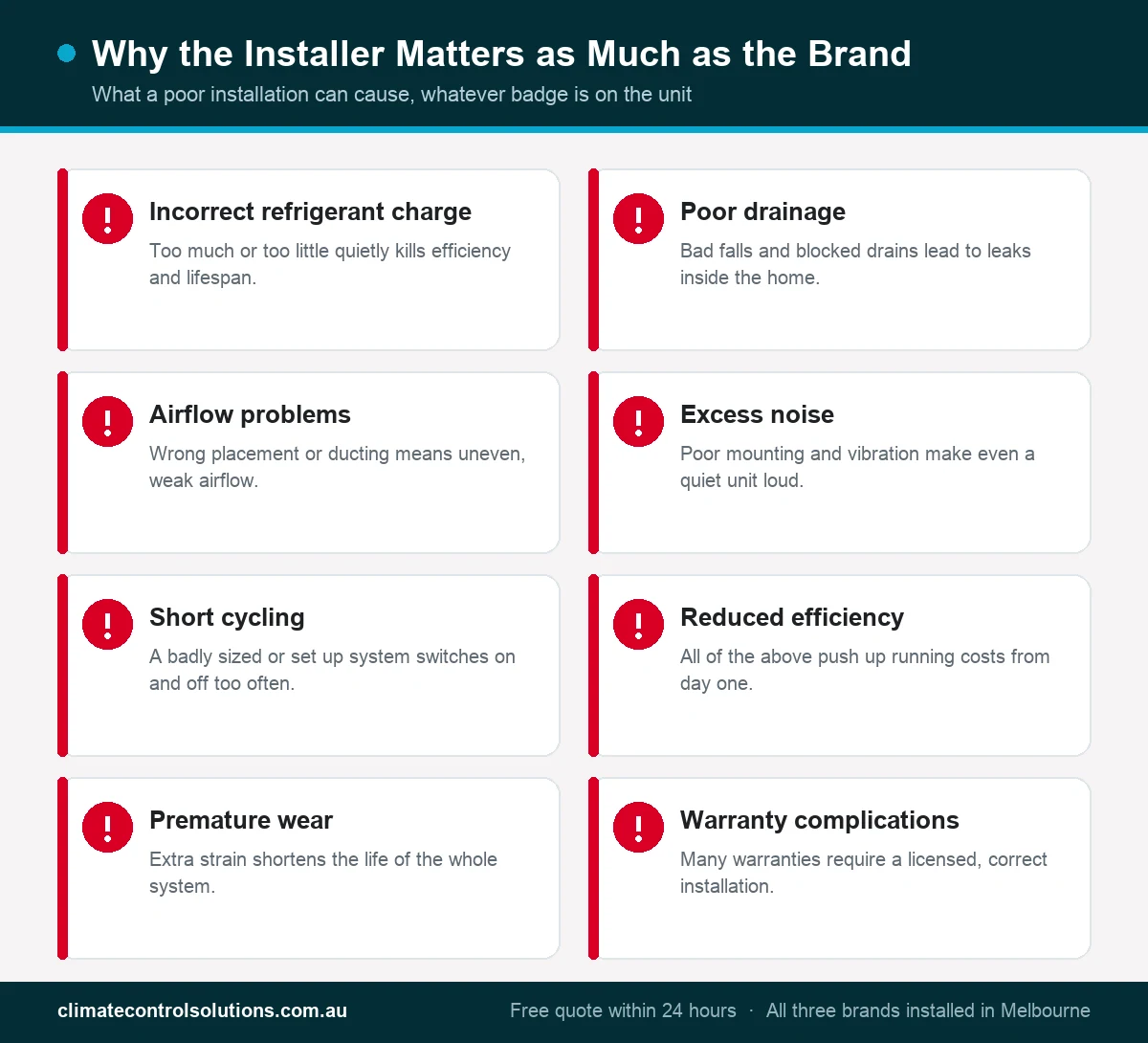
A rushed or unlicensed job can leave you with an incorrect refrigerant charge, poor drainage, airflow problems, excess noise, short cycling, reduced efficiency, premature wear and even warranty complications. A licensed, careful installer who sizes the system correctly and commissions it properly is what turns a good brand into a system that actually performs. Our installation guide covers what a proper job looks like.
Warranty, servicing and Australian support
All three brands back their residential systems with strong warranties, commonly five years, provided the system is installed by a licensed technician and registered where required. Commercial warranties can differ, and there are usually conditions around approved installers, maintenance and what is covered on parts versus labour. All three also have solid national service networks and spare-parts availability, which is one of the reasons they are so widely recommended. Warranty terms can change, so always check the current written warranty for the exact product before you buy.
Daikin vs Fujitsu vs Mitsubishi price comparison
It is tempting to want one price per brand, but that is not how it works, and any single figure would be misleading. The equipment is only part of the cost. A real quote reflects the model and capacity, standard installation, any electrical upgrades, the length of the pipework, brackets and mounting, removing an old unit, difficult or multi-storey access, and, for ducted, the ductwork and zoning. Two homes buying the same brand can pay very different amounts once those are counted.
Want a real price for your home, not a brand average?
Which brand offers the best value?
Value is not the same as cheapest. Fujitsu tends to offer the best balance of price and dependable performance, which is why it is so popular. But the best value overall counts the whole picture: purchase price, installation cost, efficiency, how much you will use it, the warranty, servicing access, and only the features you will actually use. A slightly dearer, more efficient model can be the better value across years of ownership.
Is Mitsubishi worth the premium?
Sometimes. Paying more for Mitsubishi Electric is worth it when the chosen model gives you a meaningful advantage that you will notice, such as noticeably lower noise for a bedroom, higher efficiency for heavy year-round use, or advanced features you genuinely want. It is less worth it when a cheaper equivalent from Daikin or Fujitsu already meets the property’s needs. Decide based on the specific benefit for your situation, not the badge.
Split systems compared
Split systems are where these three compete hardest. For a bedroom, look at the quietest low-capacity models, where Mitsubishi Electric often leads. For a living room, all three have strong mid-capacity options, so value and features usually decide it. For a large open-plan area, a higher-capacity split or a multi-split spreads the air better.
Whatever the room, do not choose capacity on floor area alone. Insulation, windows, orientation, ceiling height and local climate all change the right size, which is exactly what an on-site assessment sorts out. Our split system installation guide has more on getting this right.
Ducted systems compared
For whole-home comfort, all three offer capable ducted ranges, with Daikin’s being one of the broadest. But this is the category where the brand matters least and the design matters most. Duct sizing and layout, return-air sizing, zoning and the installer’s experience have a bigger effect on comfort and running costs than the small differences between these three brands. Get the design right with a good installer and any of them will serve a whole home well. Our ducted reverse cycle guide covers cost and zoning in detail.
Pros and cons of each brand
Daikin
Pros: broadest range, strong presence, split and ducted options, multiple controllers. Watch: premium pricing on some ranges, features vary by model, some smart controls cost extra.
Fujitsu
Pros: broad residential range, quiet options, competitive value, well supported. Watch: smart features can vary, wifi optional on some models, availability differs by installer.
Mitsubishi Electric
Pros: premium positioning, strong efficiency, very quiet models, advanced features. Watch: higher pricing on equivalents, smart controls may add cost, do not confuse with Heavy Industries.
Which brand is best for different Australian households?
Rather than one universal winner, here is the direction we would point different households, then confirm with the actual models.
| Household need | Recommended direction |
|---|---|
| Budget-conscious buyer | Compare Fujitsu and entry or mid-range Daikin models |
| Premium efficiency | Compare the top Mitsubishi Electric and Daikin models |
| Quiet bedroom | Compare the exact low-capacity noise ratings, Mitsubishi Electric often leads |
| Large family home | Consider ducted or a multi-split, Daikin and Mitsubishi Electric both suit |
| Melbourne heating and cooling | Prioritise reverse cycle heating efficiency in the chosen model |
| Smart-home user | Compare built-in versus optional wifi and controllers |
| Apartment or townhouse | Prioritise outdoor noise and any installation restrictions |
| Long-term owner | Prioritise warranty, servicing access and local support |
Final verdict: Daikin, Fujitsu or Mitsubishi?
After all of that, here is the honest bottom line:
Choose Daikin if
You want a strong all-rounder with the widest choice of split and ducted systems for any part of the home.
Choose Fujitsu if
You want dependable, quiet performance and competitive value from a widely supported brand.
Choose Mitsubishi Electric if
You prioritise premium efficiency, very quiet running and advanced features, and the model earns its price.
Choose on the installer if
Equivalent models are close in price and specs, which they often are. Then the installer decides the result.
The best outcome almost never comes from simply buying the most expensive brand. It comes from choosing the right capacity and model for your home, and having it installed and commissioned properly. Get those right and all three of these brands will keep you comfortable for years. If you want a shortlist beyond these three, our top 10 air conditioner brands guide covers the wider market.
Frequently asked questions
Is Fujitsu better than Daikin?
Neither is simply better. Daikin tends to win on range and whole-home options, while Fujitsu often wins on price for a comparable, dependable system. The right answer depends on the specific models you are comparing, their noise and efficiency ratings, and the quality of the local installer support behind them.
Is Daikin better than Mitsubishi Electric?
Both are top-tier and genuinely close. Daikin suits buyers who want the broadest choice of split and ducted systems, while Mitsubishi Electric appeals to those prioritising premium efficiency, refined operation and very quiet running. Compare the equivalent Australian models rather than the brands as a whole.
Which is better, Fujitsu or Mitsubishi?
It comes down to value versus premium. Fujitsu gives you a trusted, quiet system at a competitive price, while Mitsubishi Electric sits above it on efficiency, features and refinement, for a higher cost. If the cheaper Fujitsu model already meets your needs, the premium may not be worth it. If you want the extra efficiency or quietness, Mitsubishi Electric earns it.
Which is the most reliable: Daikin, Fujitsu or Mitsubishi?
All three are well-established, reliable brands in Australia with strong support networks. Real-world reliability depends far more on choosing the right model, sizing it correctly, installing it properly and maintaining it than on the badge. A well-installed Fujitsu will outlast a poorly installed premium unit.
Which brand is the quietest?
Mitsubishi Electric has a strong reputation for very quiet indoor units, and Daikin’s premium models are also very quiet. Rather than assume, compare the decibel rating of the exact indoor unit you are considering, and remember that good installation and mounting affect real-world noise just as much.
Which air conditioner is most energy efficient?
There is no single most efficient brand, because efficiency varies by model and capacity. The top premium models from Daikin and Mitsubishi Electric achieve very high ratings. To compare fairly, look at the Zoned Energy Rating Label and the cooling and heating star ratings for equivalent capacities in your climate zone.
Which brand is best for Melbourne weather?
For Melbourne you want a reverse cycle system that both cools through summer and heats efficiently through our cold winters. All three brands offer strong reverse cycle ranges. The key is matching the model and capacity to your property and prioritising heating efficiency, since the system will work hard in both seasons.
Which brand has the best warranty in Australia?
All three offer strong residential warranties, commonly five years, when the system is installed by a licensed technician and registered where required. Warranty terms and conditions can change, so check the current written warranty for the exact product, and confirm what is covered on parts versus labour.
Does the air conditioner installer matter?
Yes, enormously. Correct sizing, a proper refrigerant charge, good drainage, tidy pipework and careful commissioning make the difference between a system that runs efficiently for years and one that is noisy, inefficient or fails early. With three brands this close in quality, the installer is often the deciding factor.
Need help choosing the best air conditioner for your Melbourne home?
We install Daikin, Fujitsu and Mitsubishi Electric across Melbourne and will compare suitable models for your property, room size and budget, then install it properly. Book a free assessment and we will get back to you within 24 hours.
