



Picking an air conditioner should be simple, but walk into any showroom and you are hit with a wall of brands, star ratings and features that all start to blur together. Which of them actually last? Which are quiet? Which are worth the extra money, and which are quietly overpriced? This guide cuts through the noise.
Below we compare the best air conditioner brands in Australia, from the premium names to the value options, with honest notes on where each one shines. It is built on what we see in real homes, not marketing brochures. By the end you will know the top brands, how they stack up, and how to choose the right one for your home.
For most Australian homes, Daikin and Mitsubishi Electric are the safest premium picks for reliability, efficiency and quiet running. Fujitsu and Midea offer the best value, while LG and Samsung lead on smart features. The genuinely best air conditioner for you comes down to your room size, your budget, and how much you value efficiency and features, not just the badge on the front.
Want the right brand matched to your home and budget?
What are the best air conditioner brands in Australia?
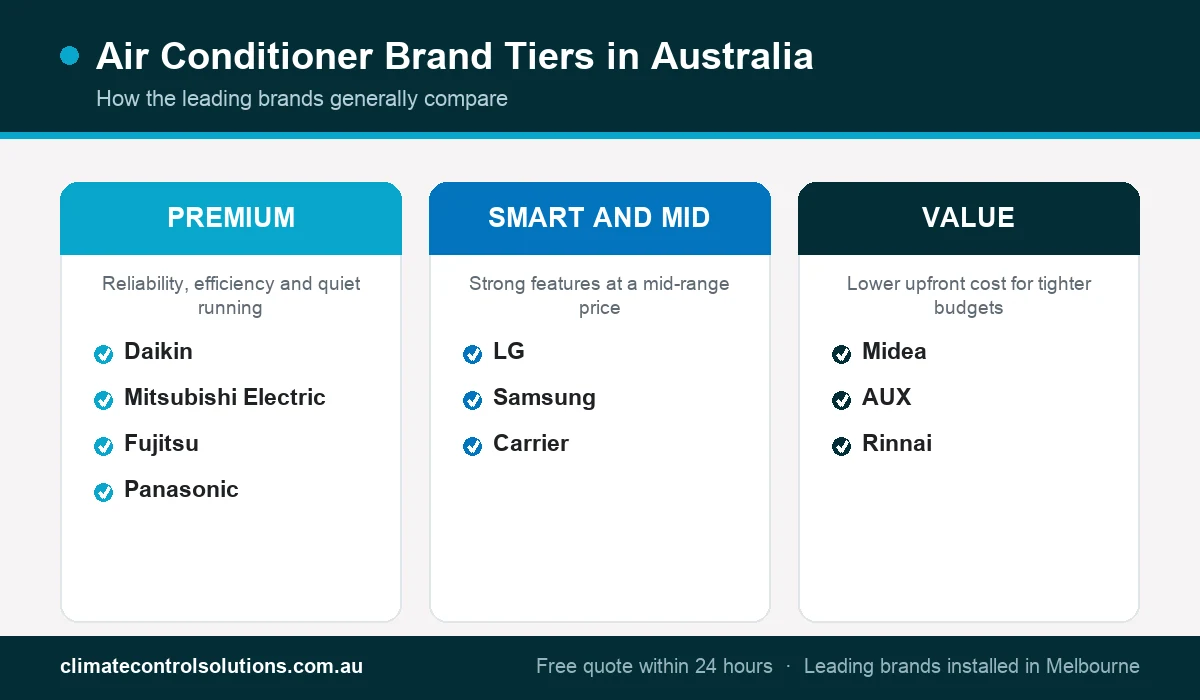
It helps to think about the market in three tiers. At the top sit the premium names built for reliability and efficiency. in the middle are strong all-rounders that lead on smart features and value. And at the value end are budget brands that cover the basics for less.
Top 10 air conditioner brands compared
Here is the quick comparison at a glance. Price is shown as a rough tier, from budget ($) to premium ($$$), and warranty cover runs from five to seven years depending on the brand, counted from professional installation.
| Brand | Best for | Efficiency | Noise | Price | Warranty |
|---|---|---|---|---|---|
| Daikin | Overall reliability | Very high | Very low | $$$ | 5 years |
| Mitsubishi Electric | Quiet premium performance | Very high | Very low | $$$ | 5 years |
| Panasonic | Air quality features | High | Low | $$ | 5 years |
| Fujitsu | All-round value | High | Low | $$ | 5 years |
| Midea | Budget buyers | Good | Moderate | $ | Up to 7 years |
| LG | Smart home control | High | Low | $$ | 5 years, compressor 10 |
| Carrier | Ducted and commercial | High | Moderate | $$ | 7 years |
| Samsung | Design and smart features | High | Very low | $$ | 5 years, compressor 10 |
| Rinnai | One brand for heat and cool | Good | Low | $$ | 7 years |
| AUX | Lowest upfront cost | Good | Moderate | $ | Varies by seller |
A quick word before the detail: the brand matters, but the install matters just as much. Even the best unit will underperform if it is the wrong size or poorly fitted.
We install a range of leading brands across Melbourne, and as a Mitsubishi Electric Diamond Dealer we know the premium end especially well. You can see the air conditioning brands we install for what is available locally.
Top 10 AC Brands in Australia 2026: Which One Is the Best Fit for You?
Here is a closer look at each of the top 10 air conditioner brands in Australia. For every brand we cover who they are, the ranges actually sold in Australia right now, verified numbers like indoor noise and energy stars, and honest notes from what we see installing and repairing systems across Melbourne.
1. Daikin: Overall Reliability
Daikin is the world’s largest air conditioning company and has been in Australia since 1969. Unlike most brands it sells only through a specialist dealer network, not retail shelves, which means units are sized and fitted by accredited installers and spare parts support is among the best in the industry. It is the brand every other brand gets measured against, and its long term service record largely earns that position.
The current wall split lineup runs from the budget Lite through Cora and Zena to the flagship Alira X, covering 2.0 kW to 7.1 kW, with the XL Series stretching to 9.5 kW for large open plan spaces. Alira X pairs built in wifi with Daikin’s Streamer air purification technology, and its 2.5 kW size earns up to 6 cooling stars on the zoned energy rating label. Small Zena and Alira X units run as low as 19 dB(A) indoors. Daikin is also the only split system brand approved by the National Asthma Council Australia’s Sensitive Choice program, which matters for allergy households. You can also see our Daikin air conditioning page for what we install and service in Melbourne. For the full lineup, visit Daikin Australia.
What we like
- Outstanding long term reliability with deep spare parts backup
- Huge range, from a single bedroom split to whole home ducted
- Only split system brand with Sensitive Choice approval for asthma and allergy households
- Very quiet small units at 19 dB(A)
Keep in mind
- You pay a genuine premium over mid tier brands
- Wifi is a plug in extra on the mid range Cora, built in only from Alira X up
- The Streamer filtration needs regular cleaning to keep doing its job
Best for: Overall reliability and whole home ducted. Current ranges: Lite, Cora, Zena, Alira X, XL. Quietest indoor unit: 19 dB(A). Warranty: 5 years parts and labour.
2. Mitsubishi Electric: Quiet Premium Performance
Mitsubishi Electric has been in Australia for more than 50 years and selling split systems here since 1983. It is the brand we install more than any other, for a simple reason: warranty claims are genuinely rare, and the indoor units are the quietest we fit. The MSZ-AP25 runs at just 18 dB(A) on its lowest setting, quieter than a whisper, which is why it is our default bedroom recommendation. As a Mitsubishi Electric Diamond Dealer our team is factory trained on exactly these systems.
The range starts with the value MSZ-GS, moves through the workhorse MSZ-AP from 2.5 kW to 7.8 kW and the slimline MSZ-EF designer series, and tops out with the premium MSZ-LN, which adds built in wifi, Plasma Quad Plus filtration and a 3D i-See Sensor that measures temperature where you are actually sitting. Dual Barrier Coating keeps the coil and fan clean so efficiency does not drift over the years, and Night Mode trims outdoor unit noise by up to 3 dB(A), a real help on tight Melbourne blocks. One thing worth knowing: Mitsubishi Electric and Mitsubishi Heavy Industries are two separate companies with different products and support networks. You can also see our Mitsubishi Electric air conditioning page for what we install and service in Melbourne. For the full lineup, visit Mitsubishi Electric Australia.
What we like
- The quietest indoor units we install, from 18 dB(A)
- Build quality that shows up as genuinely rare warranty claims
- Dual Barrier Coating keeps performance stable as the unit ages
- Strong national dealer and spare parts network
Keep in mind
- Wifi needs a separate adaptor on the AP and EF ranges, built in only on the LN
- Premium pricing to match the premium badge
- The remote packs in a lot and takes a little getting used to
Best for: Quiet premium performance in bedrooms and living areas. Current ranges: MSZ-GS, MSZ-AP, MSZ-EF, MSZ-LN. Quietest indoor unit: 18 dB(A). Warranty: 5 years parts and labour.
3. Panasonic: Air Purification
Panasonic has operated a local subsidiary since 1978 and its air conditioners consistently punch above their price. The headline is healthy air: the flagship HZ Series carries the nanoe X Generator Mark 2, which releases hydroxyl radicals that inhibit airborne pollutants, mould and odours while the unit heats or cools. Alongside Daikin, it is our usual recommendation for households managing asthma or allergies.
The lineup spans the premium HZ and Z Series down to the value RZ, from 2.5 kW to 9.5 kW, with built in wifi through the Panasonic Comfort Cloud app on the upper ranges. Quiet mode takes the small units down to around 19 dB(A), and the 2.5 kW flagship earns 5.5 cooling stars in the hot climate zone on the zoned energy rating label. iAUTO-X gives fast cooldown when you walk in on a 38 degree day, and AEROWINGS steer the airflow so it does not blow straight at you. You can also see our Panasonic air conditioning page for what we install and service in Melbourne. For the full lineup, visit Panasonic Australia.
What we like
- nanoe X air purification working whenever the unit runs
- Strong efficiency and quiet operation for the price
- Good spare parts availability in Australia
- Genuine premium features one price step below Daikin and Mitsubishi Electric
Keep in mind
- The full air quality package lives in the dearer HZ and Z Series, the entry RZ misses out
- Some owners find the fan sound less refined than Mitsubishi Electric at the same size
- Owner reviews rate its dehumidifying as middling in properly muggy weather
Best for: Air quality focused households. Current ranges: HZ, Z, RZ. Quietest indoor unit: around 19 dB(A). Warranty: 5 years parts and labour.
4. Fujitsu: All Round Value
Fujitsu has been in Australia since 1974 and built its reputation as “Australia’s favourite air” on sensible pricing and one of the strongest support setups in the country: its in house General Assist team handles warranty service nationally rather than outsourcing it. One recent change worth knowing about: after a global acquisition, the local company behind the brand became GENERAL Australia in January 2026. The units still wear the Fujitsu badge and existing warranties are unaffected.
The range runs from the entry Comfort series through the popular Lifestyle range to the flagship Lifestyle Next, covering roughly 2.5 kW to 9.4 kW. Lifestyle Next builds in wifi as standard with the myanywAiR app, which adds genuinely useful tricks like geofencing so the system reacts when you leave or head home. The 2.5 kW Lifestyle Next runs at 19 dB(A) in quiet mode and carries 5 star cooling and heating ratings, and a Human Sensor drops into economy mode when the room has been empty for about 20 minutes. You can also see our Fujitsu air conditioning page for what we install and service in Melbourne. For the full lineup, visit Fujitsu General Australia.
What we like
- Trusted Japanese engineering at a clear step below premium pricing
- in house national service team instead of third party agents
- Balanced 5 star cooling and heating on the flagship 2.5 kW, well suited to Melbourne
- Practical smart features on Lifestyle Next, not gimmicks
Keep in mind
- The standard Lifestyle range needs a paid adaptor for wifi
- Some installers report spare parts can be slower to source than Daikin
- The Fujitsu to GENERAL name change may cause some shopfront confusion during the transition
Best for: All round value with strong local support. Current ranges: Comfort, Lifestyle, Lifestyle Next. Quietest indoor unit: 19 dB(A). Warranty: 5 years parts and labour.
5. Midea: Best Budget Value
Midea is a Fortune Global 500 manufacturer and one of the largest air conditioner makers on the planet. It also builds units for plenty of other badges as an original equipment manufacturer, so there is a fair chance you have used a Midea made machine without knowing it. in Australia it has become the default value pick, and the spec sheets back that up more than you might expect: the Xtreme 2.6 kW earns 6.5 cooling stars with an energy efficiency ratio of 5.0, which out rates units costing twice as much on summer running costs.
Australian stock flows through two official channels: the trade focused Apollo and Xtreme ranges through distributor Polyaire, and retail series like Breezeless, which runs down to a genuinely quiet 21 dB(A), and GAIA with a hospital grade H13 HEPA filter. Capacities span 2.0 kW to 9.0 kW. Warranty is the detail to check: Midea advertises up to 7 years parts and labour, but the exact term depends on the product and sales channel, so confirm what applies to your unit and keep the paperwork. See our Midea air conditioner service page for what we install in Melbourne. For the full lineup, visit Midea Australia.
What we like
- Hard to beat price per kilowatt from a major manufacturer
- Class leading cooling stars on the Xtreme for the money
- Up to 7 years parts and labour cover on eligible units
- Self cleaning, wifi control and quiet modes at budget prices
Keep in mind
- Heating stars sit around 3, so it is a weaker pick as your main winter heater in Melbourne
- Installer sentiment on long term durability is mixed, plan for a shorter service life than the premium brands
- Warranty terms vary by sales channel, so confirm yours in writing
Best for: Budget cooling for secondary rooms and rentals. Current ranges: Apollo, Xtreme, Breezeless, GAIA. Quietest indoor unit: 21 dB(A). Warranty: up to 7 years, conditions apply.
6. LG: Smart Home Control
LG’s pitch is smart control done properly, and it delivers. Built in wifi and the ThinQ app come standard on the Smart Series rather than as a paid extra, with Google Assistant and Alexa support and energy monitoring inside the app. The warranty structure is also better than the headline suggests: 5 years parts and labour on the system, plus limited parts cover on the compressor out to 10 years.
The Australian lineup covers the Smart Series from 2.6 kW to 6.3 kW, the High Efficiency WH series, whose 2.5 kW unit posts an energy efficiency ratio of 4.88 with 5 star cooling and a 22 dB(A) silent mode, and the design led Artcool range with interchangeable colour panels for rooms where the unit is on show. Active Energy Control lets you cap power draw at 50, 75 or 100 percent, a simple feature that genuinely trims bills, and Smart Diagnosis flags faults through the app before you need to call anyone. See our LG air conditioner service page for what we install in Melbourne. For the full lineup, visit LG Australia.
What we like
- Built in wifi standard where rivals charge for adaptors
- Compressor parts cover out to 10 years
- Active Energy Control gives real control over running costs
- Artcool is the pick for style conscious rooms
Keep in mind
- Heating stars are mid pack, worth checking if the unit is your main winter heater
- Not as cheap as its consumer electronics image suggests
- Published noise specs are patchy on some models, ask your installer for the datasheet
Best for: Smart home control. Current ranges: Smart Series, High Efficiency, Artcool. Quietest indoor unit: 22 dB(A). Warranty: 5 years parts and labour, compressor parts to 10 years.
7. Carrier: Longest Warranty
Carrier is the company that invented modern air conditioning in 1902, and it now also owns Toshiba’s home air conditioning business worldwide. in Australia both brands are handled by distributor AHI Carrier, with the Totaline parts store network behind them. The standout number is the warranty: 7 years parts and labour on residential systems, the longest mainstream cover on this list alongside Rinnai.
The current wall split ranges are Azure, Indigo and the flagship Sapphire, spanning roughly 2.0 kW to 9.0 kW. The Sapphire 2.65 kW is quietly one of the most efficient small splits sold in Australia at 6.5 cooling stars on the zoned label, and the range heats at outdoor temperatures down to minus 15 degrees. Clever touches include Follow Me, which reads the temperature at the remote in your hand rather than at the ceiling, and Active Clean, which freezes then thaws the indoor coil to rinse it clean. See our Carrier air conditioner service page for what we install in Melbourne. For the full lineup, visit Carrier Air Australia.
What we like
- 7 year parts and labour warranty as standard
- Class leading 6.5 cooling stars on the small Sapphire
- Rated heating to minus 15 degrees, no worries on frosty mornings
- Totaline parts network and the 13 COOL support line
Keep in mind
- Indoor units start around 29 dB(A), audible next to the near silent Japanese and Korean flagships
- Smaller residential footprint in Australia, so fewer installers know the range well
- Heating stars are moderate compared with its excellent cooling numbers
Best for: Long warranty cover and efficient cooling. Current ranges: Azure, Indigo, Sapphire. Quietest indoor unit: 29 dB(A). Warranty: 7 years parts and labour.
8. Samsung: Draught Free Comfort
Samsung’s WindFree cooling is a genuinely different idea rather than a gimmick: once the room hits temperature, the unit disperses air through thousands of micro holes in the front panel, so you stay cool without a draught blowing across your bed or desk. On paper Samsung also fields the quietest unit in this entire guide, with the 2.5 kW GEO WindFree measuring just 17 dB(A) on its lowest setting, and SmartThings is arguably the most polished app in the category, with energy monitoring and voice control built in.
The Australian range is led by the AI Smart GEO WindFree Purification series from 2.5 kW to 8.0 kW, with the AI Smart Aero below it. Warranty is 5 years parts and labour, with the Digital Inverter compressor covered for parts out to 10 years. Efficiency is the honest trade off: at 4.5 cooling stars the flagship sits mid pack, behind the class leaders from Carrier and Midea in the same size. You can also see our Samsung air conditioner service page for what we install and service in Melbourne. For the full lineup, visit Samsung Australia.
What we like
- WindFree comfort is a real benefit if a unit faces the bed or sofa
- Quietest measured unit in this guide at 17 dB(A)
- SmartThings app with energy tracking and voice control
- Sharp, modern styling on the wall
Keep in mind
- Mid pack efficiency stars, so running costs trail the class leaders
- Specialist installers rate its after sales support behind the dedicated air conditioning brands
- The AI comfort features can override your set temperature until you tune the settings
Best for: Design, draught free comfort and smart features. Current ranges: AI Smart GEO WindFree, AI Smart Aero. Quietest indoor unit: 17 dB(A). Warranty: 5 years parts and labour, compressor parts to 10 years.
9. Rinnai: Local Support
Rinnai is a Japanese appliance maker with more than 50 years in Australia, and it owns the local heating names Brivis and APAC. Its strengths are local ones: a national 1st Care service network with over 300 accredited technicians, and, since April 2025, a 7 year residential warranty on its split systems, lifted from the previous 5. For buyers who want one brand and one phone number across ducted heating, hot water and cooling, that combination is hard to match.
The split lineup is led by the JX Series, which runs from minus 15 to 52 degrees outdoor and adds PM2.5 electrostatic filtration, alongside the popular T Series, the VX and PX, from 2.5 kW to 8.0 kW with built in wifi and voice control across the inverter range. The numbers are stronger than the mid tier price suggests: the 2.5 kW T Series posts 7 cooling stars in the average climate zone on the zoned label and a 22 dB(A) silent mode. You can also see our Rinnai heating and cooling page for what we install and service in Melbourne. For the full lineup, visit Rinnai Australia.
What we like
- 7 year residential warranty on splits bought since April 2025
- Big genuine local service network, not a call centre overseas
- Excellent cooling stars for the price on the T Series
- One trusted brand across heating, hot water and cooling
Keep in mind
- The splits are built overseas to Rinnai’s specification, unlike its own made gas appliances
- Heating stars on the small units are modest for a heating first city like Melbourne
- Refinement sits a step below the premium Japanese brands
Best for: Local support and one brand across the whole home. Current ranges: JX, T Series, VX, PX. Quietest indoor unit: 22 dB(A). Warranty: 7 years residential.
10. AUX: Lowest Upfront Cost
AUX is one of China’s largest air conditioner manufacturers, established in 1986, exporting to more than 160 countries and building units for other brands as well as its own. in Australia it arrives mainly through energy upgrade programs and rebate focused installers rather than retail stores, which is how it manages the lowest entry prices of any brand here. Under Victoria’s VEU rules, any unit installed through the program since March 2025 must carry at least a 5 year defect warranty.
Here is the honest part: there is no large national AUX office standing behind the brand in Australia, so warranty and parts support rest with the company that sells and installs the unit. That makes your installer choice matter more than the unit itself. Buy through an established local company you expect to still be trading in five years, keep your certificates, and ask for the model datasheet, because specs like noise and star ratings vary widely between AUX series. The features themselves are respectable for the money: full DC inverter compressors, self cleaning modes and wifi control on ranges like Q Smart and J Smart. See our AUX air conditioner service page for what we install in Melbourne. For the full lineup, visit AUX.
What we like
- The lowest entry price of the ten brands here
- Modern features like self cleaning and wifi at budget money
- A sensible choice for rentals and rarely used rooms
- Rebate program installs can shrink the cost further
Keep in mind
- Support depends entirely on the seller, there is no big national brand office behind it
- Thin brand recognition affects resale and installer familiarity
- Specs vary by model and channel, always check the datasheet before signing
Best for: Lowest upfront cost through rebate channel installs. Current ranges: C Smart, Q Smart, J Smart. Warranty: varies by seller, 5 years on VEU program installs.
Which air conditioner is the most energy efficient in Australia?
Energy efficiency is where a premium brand often pays for itself. The most efficient systems are inverter models from Daikin, Mitsubishi Electric, Fujitsu and Panasonic, which reach high star ratings and sip power compared to older or cheaper units. When you compare, the number to watch is the energy rating label, and specifically the cooling and heating star ratings for your climate zone. A unit with more stars costs a little more upfront but less every summer and winter after that. If you want to dig into the running-cost side, our guide on cooling types and efficiency is a good companion read.
What is the best split system air conditioner in Australia?
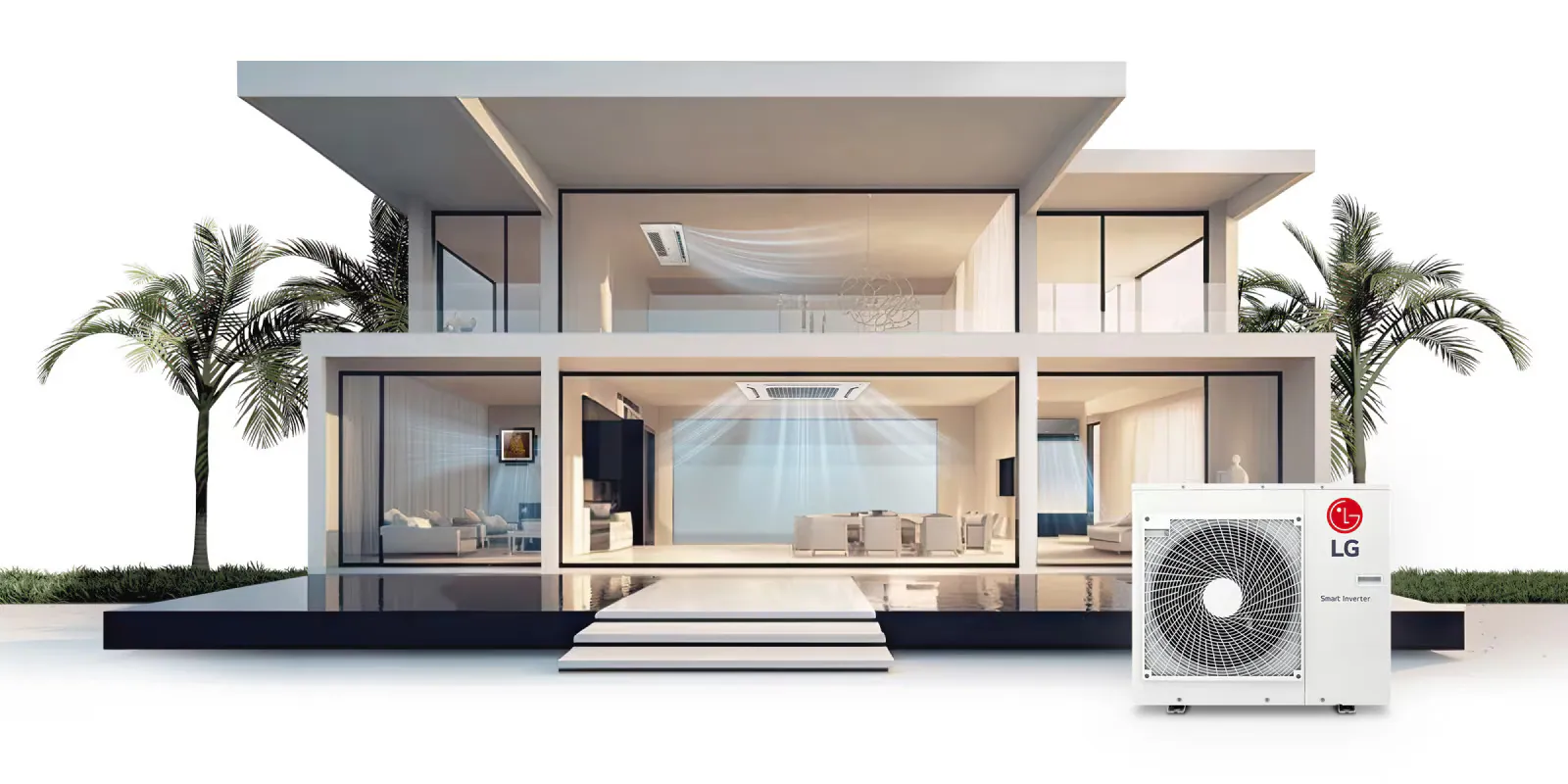
Split systems are the most popular way Australians cool and heat a room, so it is the category most brands compete hardest in. For a quiet, efficient split system, Mitsubishi Electric and Daikin lead, with Fujitsu and Panasonic close behind on value.
If you need several rooms handled from one outdoor unit, look at a multi-head split system, and if you are ready to buy, our split system installation guide covers cost and what to expect.
Which air conditioner brand offers the best value?
Value is not the same as cheapest. The best-value brands give you dependable performance without paying for a badge, and the running costs stay sensible. Fujitsu is the standout here, a trusted, widely supported brand at a fair price. Midea is the pick if the lowest upfront cost from a major manufacturer is the priority, and AUX goes lower still for a basic bedroom or rental. Just remember that an efficient premium unit can end up cheaper over its life once you count the power bills, so weigh the whole cost, not only the sticker.
Which air conditioner is best for Australian homes?
The right choice really depends on the room. Rather than one answer, here is a quick guide to the best fit for different needs.
Bedrooms
A quiet split system around 2.5 kW. Mitsubishi Electric and Panasonic are hard to beat for low noise.
Living and open plan
A larger split (7 kW or more) or ducted. Daikin, Fujitsu and Mitsubishi Electric all suit.
Whole home
A ducted reverse cycle system. Daikin and Carrier have strong ducted ranges.
Tight budget
Midea or AUX cover the basics for less, ideal for a secondary room or a rental.
How to choose the right air conditioner
Once you have a shortlist of brands, the deciding factors are the same across all of them. Get these right and almost any reputable brand will serve you well.
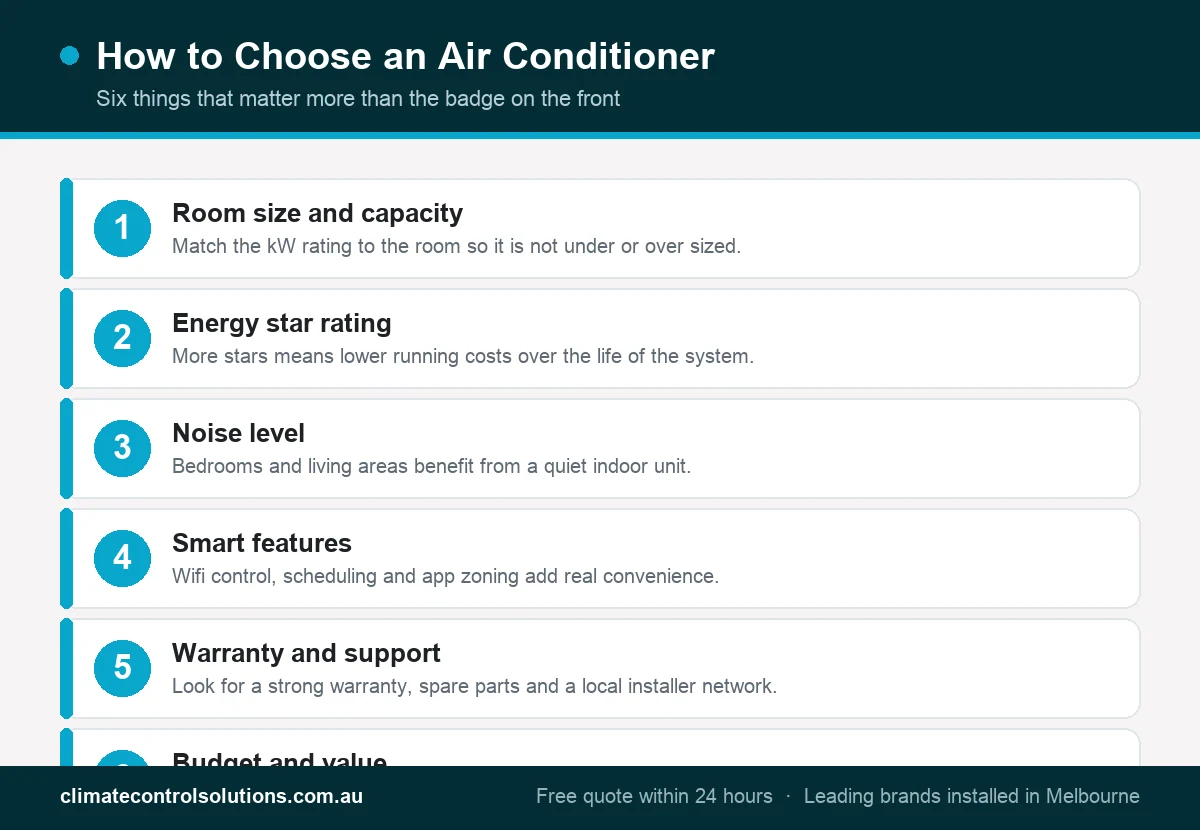
Above all, get the sizing right. An air conditioner that is too small will struggle, and one that is too big wastes money and cycles on and off. That is where an on-site assessment pays off, because the right size depends on your room, insulation, windows and how you use the space.
Related comparisons: for a closer head to head, see Daikin vs Fujitsu vs Mitsubishi, Daikin vs Mitsubishi Electric and ActronAir vs Daikin.
Frequently asked questions
What is the best air conditioner brand in Australia?
There is no single winner for everyone, but Daikin and Mitsubishi Electric are the two most consistently recommended premium brands for reliability, efficiency and quiet operation. For value, Fujitsu and Midea are strong, and for smart features, LG and Samsung stand out. The best brand for you depends on your room, budget and how much you value efficiency and features.
Which air conditioner brand is most reliable?
Daikin and Mitsubishi Electric have the strongest reputations for long-term reliability in Australia, backed by quality build and good spare-parts support. Fujitsu and Panasonic are also well regarded. Reliability also depends heavily on a correct installation, so a licensed installer matters as much as the badge.
Is Daikin better than Mitsubishi Electric?
Both are top-tier and genuinely hard to separate. Daikin has the broader range and a slight edge in ducted, while Mitsubishi Electric is often praised for being especially quiet and efficient in split systems. For a bedroom, many people lean Mitsubishi Electric; for whole-home ducted, Daikin is a common pick. You would be well served by either.
Which air conditioner is most energy efficient?
The most efficient systems are premium inverter models from Daikin, Mitsubishi Electric, Fujitsu and Panasonic, which achieve high star ratings. When comparing, check the energy rating label and the cooling and heating star ratings for your climate zone, since a higher rating means lower running costs over the life of the system.
What is the quietest split system air conditioner in Australia?
Mitsubishi Electric and Panasonic are consistently among the quietest split systems, with indoor noise levels low enough to suit a bedroom or study. Daikin’s premium models are also very quiet. If low noise is your priority, look at the decibel rating of the indoor unit before you buy.
Which air conditioner is best for a bedroom?
For a bedroom you want a quiet, right-sized split system, which is where Mitsubishi Electric and Panasonic shine. A unit around 2.5 kW suits most bedrooms, but the correct size depends on the room, so it is worth having it sized properly rather than guessing.
Which air conditioner brand offers the best value?
Fujitsu and Midea offer the best balance of price and dependability for most buyers. Fujitsu gives you a trusted, widely supported brand at a fair price, while Midea is the go-to for the lowest cost from a major manufacturer. The best value overall counts running costs too, so a slightly dearer efficient unit can be cheaper across its life.
Are cheaper air conditioner brands worth buying?
They can be, especially for a secondary room, a rental or a tight budget. Budget brands like Midea and AUX cover the basics well and have improved a lot. Just weigh up the lower upfront price against efficiency, noise, warranty and spare-parts support, since a premium unit often costs less to run over time.
Is Fujitsu a good air conditioner brand?
Yes. Fujitsu General is one of the most popular and trusted brands in Australia, offering a reliable, well-supported range at a competitive price. It is a sensible middle-ground choice between budget brands and the top premium names.
What air conditioner brands should you be careful with in Australia?
Rather than naming brands to avoid, look for warning signs when comparing any brand: a weak or short warranty, limited availability of spare parts, a thin local installer and service network, and unclear or missing energy efficiency ratings. A well-known brand with strong local support and clear ratings is a safer long-term bet than an unknown unit with none of those.
Not sure which air conditioner brand is right for you?
We install leading air conditioner brands across Melbourne and will match the right system to your home, room and budget. Book a free on-site assessment and we will get back to you within 24 hours.
